Hall of the designers
The People
Aircraft are decisions made by particular people. These are the engineers, theorists, and pilots whose judgment shaped the American jet age.
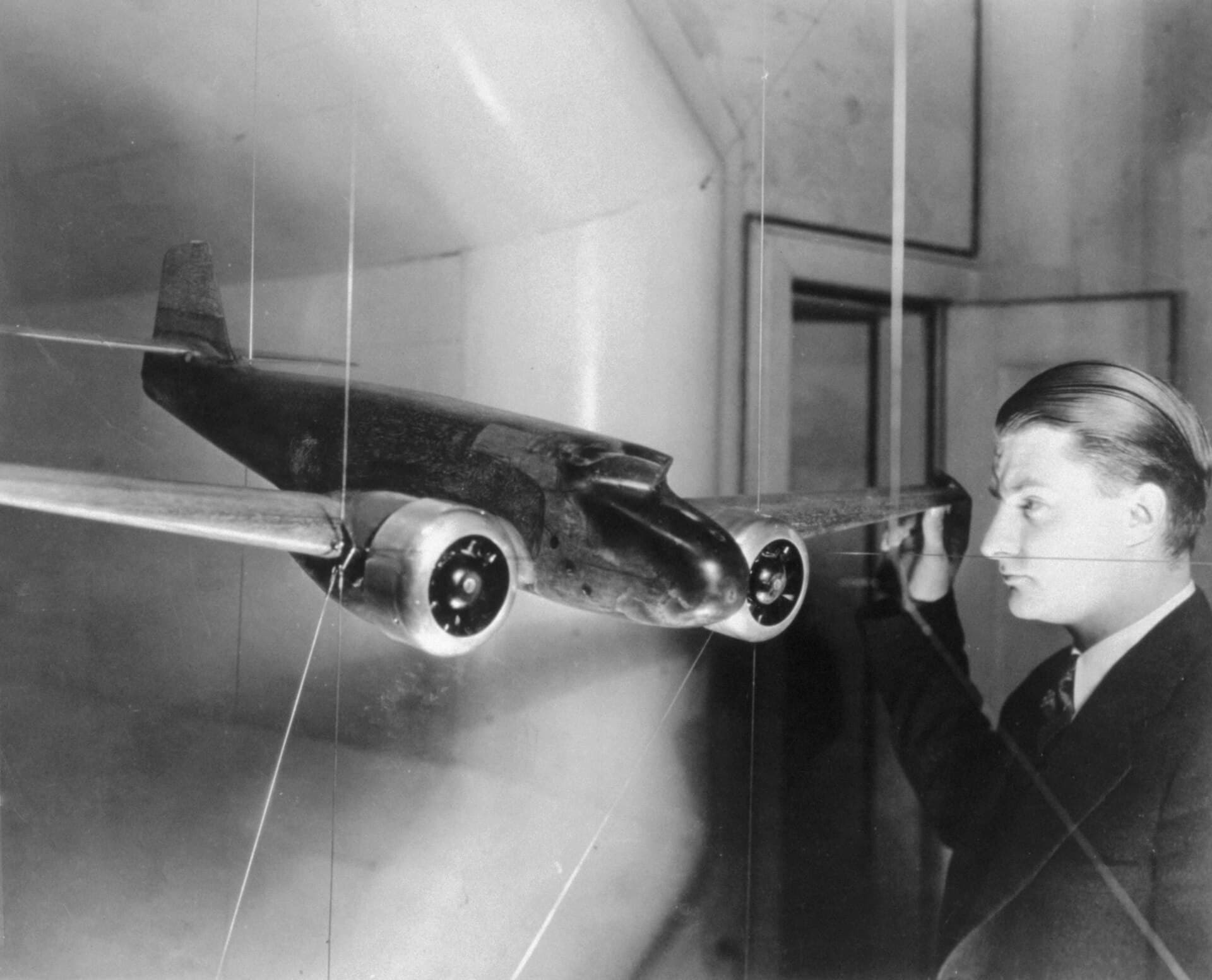
Clarence “Kelly” Johnson
1910–1990 · Founder of the Lockheed Skunk Works
Johnson joined Lockheed in 1933 as a 23-year-old tool designer who promptly told his bosses their new Electra airliner was unstable — then fixed it in the University of Michigan wind tunnel. He contributed to more than forty aircraft, but his monument is a method: the Skunk Works, born in 1943 when he built the XP-80 jet fighter in 143 days inside a rented circus tent.
His '14 Rules' — small teams, near-absolute authority for the program manager, minimal paperwork, engineers within walking distance of the shop floor — produced the U-2 in eight months and the Mach 3 Blackbird family with slide rules. He is the only person to win the Collier Trophy twice for aircraft he personally designed, and he turned unspent government money back in.
Aircraft in this collection: P-80 lineage, F-104 Starfighter, U-2, SR-71.
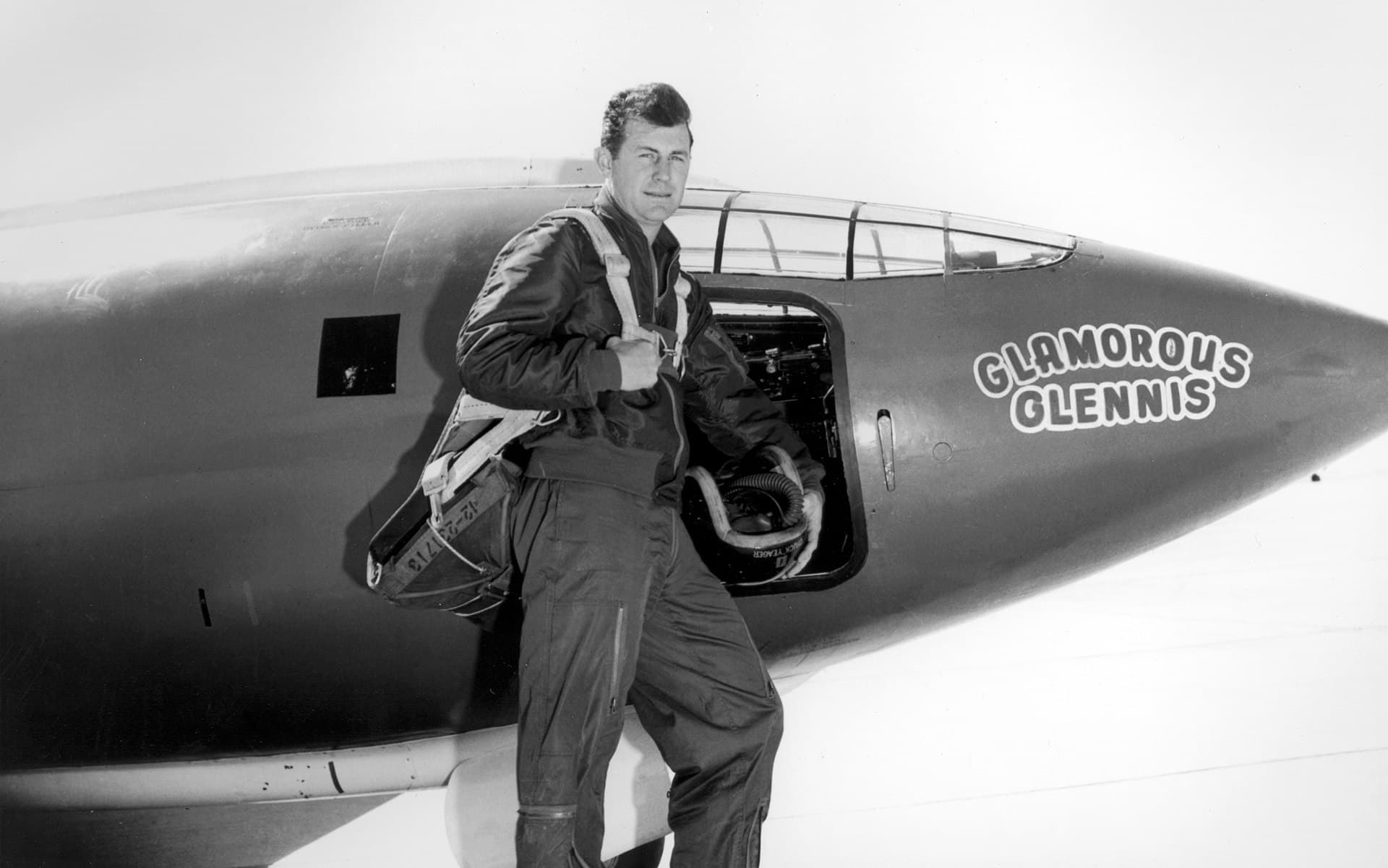
Chuck Yeager
1923–2020 · First through the sound barrier
A West Virginia ace with 20/10 vision and no college degree, Yeager broke the sound barrier in the Bell X-1 on October 14, 1947 — flying with two ribs broken in a horse-riding accident he hid from the flight surgeon, using a sawn-off broom handle to close the hatch.
The flight proved the 'barrier' was an engineering problem, not a wall: the X-1's all-moving tail (the same solution that later made the F-86 lethal) kept control through the transonic shock. Yeager went on to command the USAF test pilot school and nearly died in the NF-104 zoom-climb accident of 1963.
Aircraft in this collection: the X-1's flying tail lives on in the F-86; the NF-104 story belongs to the Starfighter.
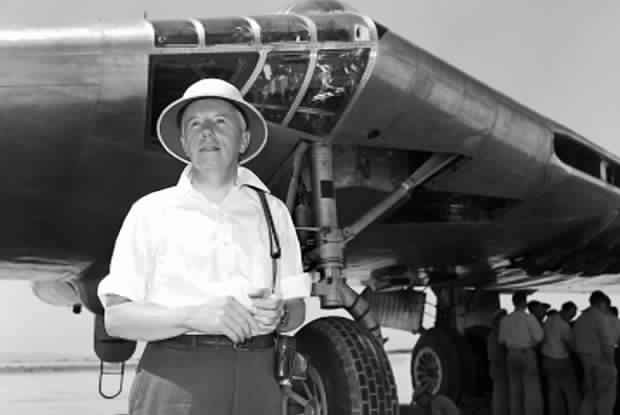
Jack Northrop
1895–1981 · The flying wing's true believer
A self-taught engineer who never finished more than high school, Northrop co-founded Lockheed, founded Northrop Corporation, and spent his life chasing the aerodynamically pure aircraft: a single flying wing with no fuselage and no tail. His YB-35 and jet YB-49 bombers flew in the late 1940s but were cancelled — the wing was efficient yet nearly impossible to stabilize with 1940s technology.
In April 1980, aged 85 and unable to speak after a stroke, he was cleared into a secure room and shown the classified model of Northrop's B-2 — a flying wing with his exact 172-foot span, now flyable thanks to digital flight controls. He wrote on a notepad: 'Now I know why God has kept me alive for 25 years.' He died ten months later.
Aircraft in this collection: B-2 Spirit.
Also in this hall
Ben Rich
1925–1995 · Second leader of the Skunk Works; father of stealth
Johnson's thermodynamicist on the U-2 and SR-71 (the Blackbird's inlets — and its black paint — are his), Rich bet the Skunk Works on stealth in 1975 and delivered the F-117. His memoir “Skunk Works” (1994), the book that inspired this museum, remains the best first-person account of black-program engineering ever published. No freely licensed photograph of Rich exists, so — per this museum's real-images-only rule — his portrait spot stays empty.
John Boyd
1927–1997 · Energy-maneuverability theorist
The Air Force's most influential unpromotable colonel. His E-M theory turned fighter agility into equations, his Fighter Mafia forced the F-16 into existence, and his OODA loop escaped aviation entirely into business and military doctrine.
George Schairer
1913–2004 · Boeing chief aerodynamicist
Saw the German swept-wing data at Braunschweig in May 1945 and airmailed it to Seattle. The B-47, B-52, and the 707 lineage all trace to that envelope — and to Schairer's judgment that the data was right.
Denys Overholser
1930s–2024 · The mathematician who made stealth computable
Read Ufimtsev's Soviet diffraction theory, recognized what it meant, and wrote ECHO 1 — the program that let Lockheed design the F-117 by predicting its radar return. Kelly Johnson bet Ben Rich a quarter the faceted airplane wouldn't beat the D-21 drone's signature; Johnson paid up.
Edgar Schmued
1899–1985 · Designer of the P-51 and F-86
German-born, largely self-taught, twice designer of the definitive American fighter of an era — the piston Mustang and the jet Sabre.
Harry Hillaker
1919–2009 · Father of the F-16
Sketched the lightweight fighter with John Boyd over drinks at the Officers' Club, then spent a decade making the heretical design — small, unstable, fly-by-wire — into the West's standard fighter.
Portraits appear only where an authentic public-domain photograph exists — this museum uses no stock or generated imagery. Read more about each person on the relevant exhibit pages.