Exhibit 15 · Fairchild Republic
A-10 Thunderbolt II
“Warthog”
A titanium bathtub, a 30mm cannon, and the airplane built around both.
History
Vietnam proved that fast jets were terrible at close air support: too fast to see the fight, too fragile to survive ground fire, too fuel-limited to stay. The A-X program — championed by Pierre Sprey and the reformers around John Boyd — specified the opposite of every fashionable metric: slow enough to aim, armored enough to be shot, simple enough to fly from forward strips, and cheap enough to buy in quantity.
Fairchild Republic (heir to the P-47 Thunderbolt's builder) won the 1972 flyoff by designing the aircraft literally around its gun: the GAU-8 Avenger, a 30mm hydraulically-driven seven-barrel cannon nearly the length of a car, firing milk-bottle-sized depleted-uranium rounds designed to open Soviet tanks from above.
The Air Force never loved it — it is slow, unglamorous, and institutionally orphaned — and has tried to retire it roughly once a decade since 1990. Congress, and events, keep intervening: Desert Storm (987 tank kills claimed), the Balkans, Afghanistan, Iraq. Troops in contact do not ask for anything else by name. The 'BRRRRT' is the only engine-and-gun sound with its own meme economy.
Why it mattered
The A-10 is the purest American expression of requirement-driven design — every configuration decision traces to survivability and the gun — and the longest-running argument in U.S. defense politics: the institutional Air Force versus the mission nobody else wants and everybody needs. It is also the only aircraft in this museum designed to be shot and keep flying, a philosophy with no other modern representative.
Engineering breakdown
Airframe & structure
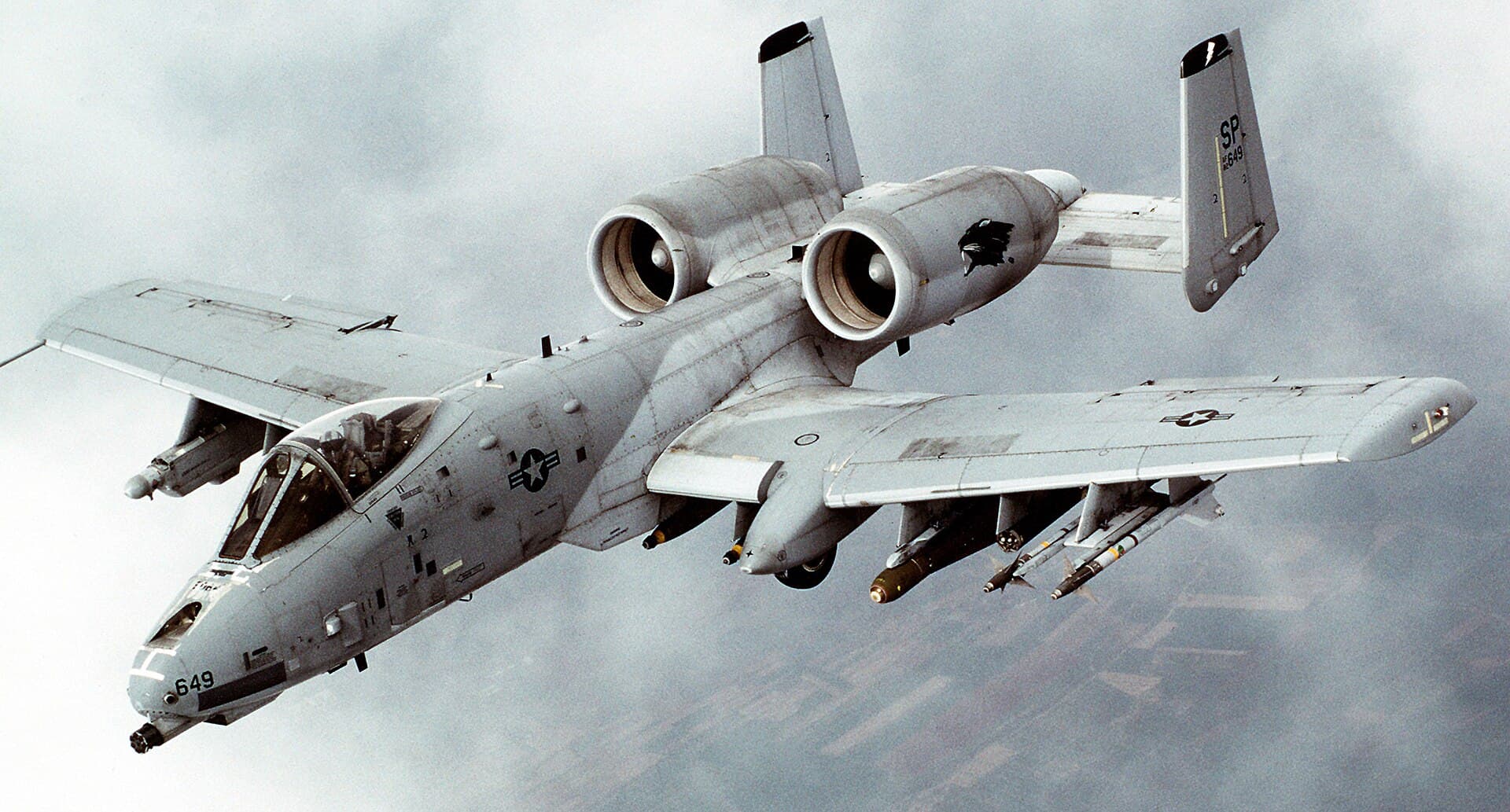
The pilot sits in a 1,200-lb titanium 'bathtub' — plate from 0.5 to 1.5 inches thick — proof against 23mm cannon fire, with the canopy rated for small arms. Flight controls are doubly redundant hydraulics with a full manual-reversion cable mode: pilots have landed with both hydraulic systems shot away. Engines mounted high and aft, shielded from ground fire by wing and tail, and positioned so the aircraft can taxi over unimproved surfaces without ingesting debris.
Materials
Titanium armor tub; otherwise deliberately ordinary aluminum, chosen for battle-damage repair with hand tools — panels are interchangeable left-right, and the gear legs, halves of the vertical tails, and many skins are common parts. Main wheels protrude half-exposed from their pods so a gear-up landing grinds pods, not structure.
Aerodynamics
A big straight wing (aspect ratio and thickness closer to a 1940s design than a 1970s one) gives docile low-speed handling, a 4,000-ft-strip capability, and the loiter endurance that defines the mission: hours over the fight, not minutes. Speed was explicitly traded away — the requirement valued time-on-station and turning inside a valley over Mach anything.
Key innovations
- Titanium bathtub cockpit armor — the pilot as the design's protected core
- Full manual-reversion flight controls after total hydraulic loss
- GAU-8 integration: the airframe designed around the weapon (the gun sits offset so the firing barrel lies on centerline; the nose gear moved sideways to make room)
- Damage-tolerant redundancy: designed to fly home with one engine, one tail, one elevator, and half a wing missing — and has
Propulsion
2× General Electric TF34-GE-100
General Electric · High-bypass turbofan (6.2:1 bypass ratio) · 9,065 lbf each
A high-bypass fan — airliner technology, from the S-3 Viking's engine — on an attack jet was heresy in 1972 and exactly right: sips fuel for long loiter, runs cool and quiet (small infrared and acoustic signature — the A-10 famously arrives unheard), and its placement high on the aft fuselage lets the wing and tailplanes mask the exhaust from heat-seeking missiles below. Firing the GAU-8 ingests gun gas that can flame out the engines; igniters fire automatically with every trigger pull.
Specifications
The people
Lore
The GAU-8's recoil is roughly equal to one engine's thrust; the gun fires on the centerline so recoil doesn't yaw the aircraft off aim.
Official name 'Thunderbolt II' honors the P-47; nobody has ever used it. It is the Warthog, or the Hog, and its gun-run sound is spelled BRRRRT.
The A-10 has survived retirement attempts in 1990, 2015, and repeatedly since — the only aircraft whose obituary has been drafted more often than its replacement.
Facts for the placard
- The GAU-8 assembly (gun + feed + drum) weighs about 4,000 lb — roughly a tenth of the aircraft's empty weight.
- A-10s claimed 987 tanks, 1,355 vehicles, and 926 artillery pieces in Desert Storm.
- Depleted-uranium API rounds self-sharpen as they penetrate — the round was designed for the gun, the gun for the airplane.
Sources & further reading
- U.S. Air Force — A-10C Thunderbolt II official fact sheet
- National Museum of the USAF — Fairchild Republic A-10A fact sheet
- Northrop Grumman (Fairchild heritage) — A-10 program records
- Photograph: An A-10 Thunderbolt II of the 52nd Fighter Wing, Spangdahlem, in flight. U.S. Air Force photo (public domain), via Wikimedia Commons.