Exhibit 14 · Grumman
F-14 Tomcat
Swing wings, a hundred-mile missile, and the burden of being adored.
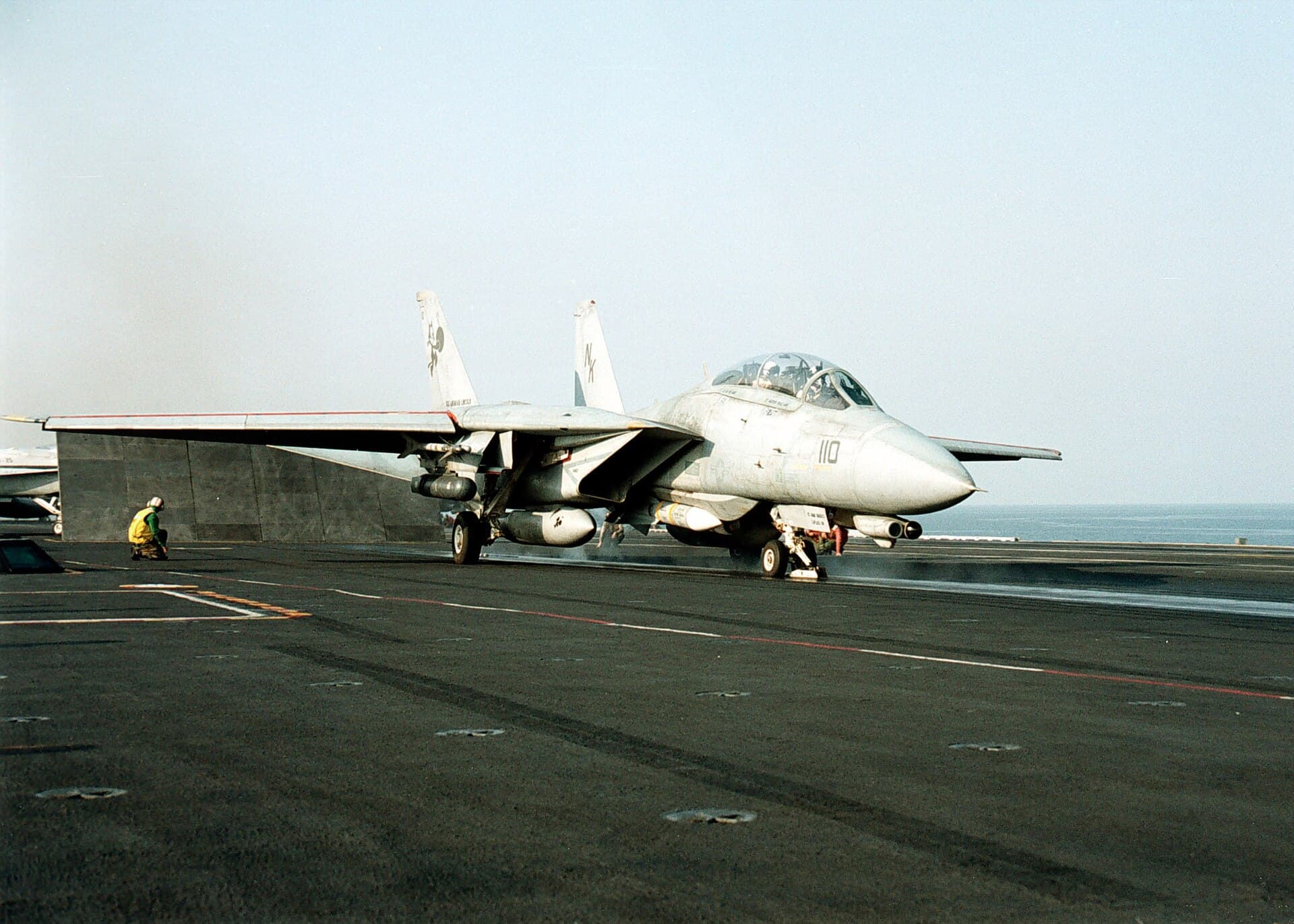
History
The Tomcat was born from a fiasco: the Navy's forced marriage to the F-111B, a swing-wing bomber-sized 'fighter' that could not survive around a carrier. Grumman — the F-111B's subcontractor, and the Navy's fighter house since the 1930s — quietly designed its escape: the same engines, radar, and missiles repackaged in an actual fighter. When Congress killed the F-111B in 1968, the VFX proposal was waiting.
Its mission was singular: stand between the carrier and regiments of Soviet bombers launching cruise missiles from 200 miles out. The AWG-9 radar could track 24 targets and engage six simultaneously with AIM-54 Phoenix missiles at ranges over 100 miles — a capability no other fighter on earth possessed, before or for decades after.
Tomcats splashed Libyan Su-22s (1981) and MiG-23s (1989) over the Gulf of Sidra, but its strangest combat record belongs to Iran: F-14s delivered to the Shah before 1979 fought through the Iran–Iraq War with disputed but substantial success, and Iranian Tomcats remain the type's only operators today. 'Top Gun' (1986) made it the most famous aircraft in the world; the Navy retired it in 2006, mothballed the fleet, and shredded most of it specifically to keep parts from reaching Iran.
Why it mattered
The F-14 represents the maximalist answer to fleet defense — the biggest radar, longest missile, and most complex wing ever hung on a carrier fighter — and the last of Grumman's Cats, ending the dynasty (Wildcat, Hellcat, Panther, Tiger) that had defended the fleet since Guadalcanal. It is also a procurement parable: born from one failed commonality program (F-111B), it validated the escape hatch.
Engineering breakdown
Airframe & structure
Variable-geometry wings sweeping automatically from 20° (slow, high-lift for the carrier pattern) to 68° (supersonic dash), scheduled continuously by an air-data computer — the pilot never touches them. The two engine nacelles sit far apart under a broad flat 'pancake' between them; that pancake generates 40–60% of total lift, making the fuselage itself a lifting body and giving the Tomcat its improbable agility for a 33-ton aircraft.
Materials
First production use of a boron-epoxy composite structure (the horizontal stabilizer skins) plus a titanium wing box carrying the swing-wing pivot loads — the pivots were electron-beam welded titanium, machined to bearing tolerances at structural scale.
Aerodynamics
Variable sweep solves the carrier fighter's contradiction: a straight wing for 125-knot approaches, a swept delta for Mach 2.3, in one airframe. Glove vanes near the wing roots extended automatically at high Mach to control the center-of-lift shift. The price was weight, mechanical complexity, and a maintenance burden that eventually retired it.
Key innovations
- Automatic continuously-scheduled variable-geometry wings
- AWG-9 + AIM-54 Phoenix: track-while-scan on 24 targets, six simultaneous 100+ mile engagements — unmatched for 20 years
- Lifting pancake fuselage between widely-spaced nacelles
- First production boron-composite structural component
Propulsion
2× Pratt & Whitney TF30-P-414A (F-14A) → GE F110-GE-400 (F-14B/D)
Pratt & Whitney / General Electric · Afterburning turbofan · 20,900 lbf (TF30) → 27,000 lbf (F110), each
The TF30 — inherited from the F-111 program — was the Tomcat's tragic flaw: prone to compressor stalls at high angle of attack precisely when a fighter needs thrust most, and stall-induced flat spins killed crews (the Secretary of the Navy called the pairing 'probably the worst engine-airplane mismatch in years'). The GE F110 retrofit transformed the aircraft — 30% more thrust, stall-free, catapult launches without afterburner — and the F-14B/D flew like the fighter Grumman had drawn. The lesson recurs across this museum: the airframe is the promise, the engine is the truth.
Specifications
The people
Lore
The 'Tomcat' name is a double tribute: Grumman's feline dynasty, and Admiral 'Tomcat' Connolly, who fell on his sword to kill the F-111B.
Iran's F-14s were sold with the Phoenix missile before the revolution; U.S. planners spent the next forty years wargaming against their own masterpiece.
'Top Gun' put the Tomcat on more bedroom walls than any fighter in history; Navy recruiting offices reported queues the summer of 1986.
Facts for the placard
- The swing-wing pivots never suffered a structural failure in 36 years of carrier service.
- An F-14 could hold six Phoenix missiles — a loadout so heavy it couldn't land back aboard with it.
- Retired U.S. Tomcats were deliberately shredded to deny spare parts to Iran — the only U.S. fighter disposed of as counter-proliferation.