Exhibit 13 · Lockheed (Skunk Works)
F-117A Nighthawk
The airplane designed by an equation: faceted, invisible, and secret for a decade.
History
In 1974, Skunk Works mathematician Denys Overholser found the key in an obscure paper by Soviet physicist Pyotr Ufimtsev — 'Method of Edge Waves in the Physical Theory of Diffraction' — which made it possible to calculate the radar reflection of a shape built from flat panels. Lockheed's ECHO 1 software could only handle flat facets, so the airplane became flat facets: engineers called the concept the 'Hopeless Diamond'.
The Have Blue demonstrators (1977) proved a faceted aircraft could both fly and vanish from radar; its radar cross-section measured orders of magnitude below any aircraft ever tested — on the pole, small birds returned more signal. Full-scale development of the F-117A began in 1978 under total secrecy; squadrons flew only at night out of Tonopah for five years while the world knew nothing.
On the first night of Desert Storm in January 1991, F-117s flew straight through the densest air-defense network ever assembled and put laser-guided bombs through the ventilation shafts of downtown Baghdad's hardest targets. Flying about 2% of attack sorties, they struck roughly 40% of the strategic target list, without a single aircraft touched. One F-117 was lost to a Serbian SA-3 battery in 1999 — the only combat loss.
Why it mattered
The Nighthawk did to radar what the U-2 did to altitude and the SR-71 did to speed: it made an entire generation of defenses obsolete overnight. It is not fast, not agile, and carries only two bombs — because low observability replaced all of those as the currency of survival. Every combat aircraft designed since is shaped by that inversion. The stealth breakthrough came from an unclassified Soviet paper — a reminder that the U.S. lead lay not in secrets, but in recognizing and industrializing an idea faster than its country of origin could.
Engineering breakdown
Airframe & structure
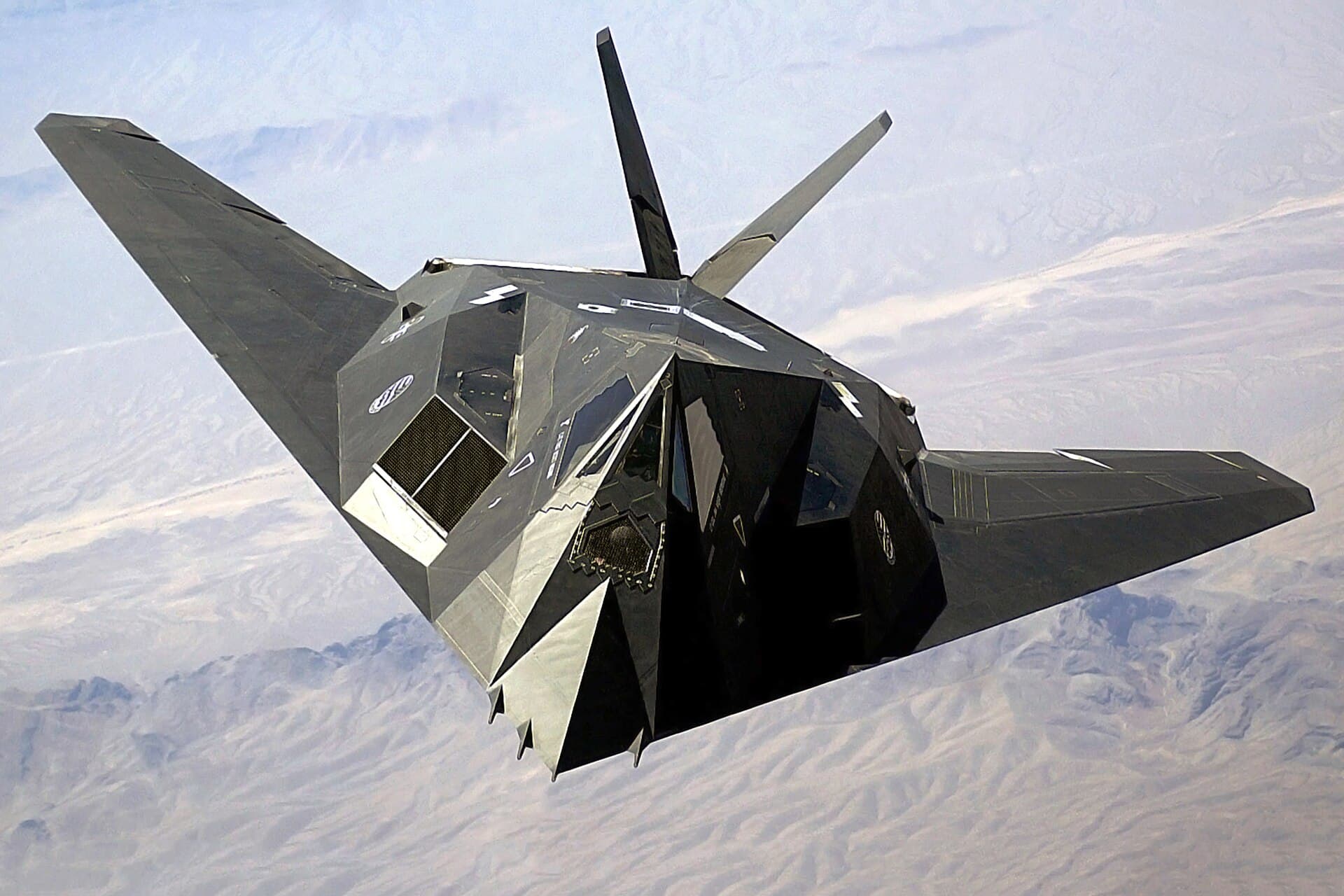
A faceted arrowhead of flat panels, every one angled to deflect radar energy away from the emitter — computation, not aerodynamics, dictated the shape. The result is longitudinally and directionally unstable in all three axes; it is flyable only because quadruple-redundant fly-by-wire computers (borrowed from the F-16) command corrections constantly. Pilots called it the 'Wobblin' Goblin' early on; in fact it flew smoothly — the computers did the wobbling.
Materials
Conventional aluminum structure — deliberately, to keep risk in one place (the shape) — skinned with radar-absorbent material (RAM) coatings and sawtooth-edged panels. Gold-coated canopy glass and gridded intake screens keep the cockpit and engine faces (a fighter's brightest radar reflectors) from returning signal.
Aerodynamics
Faceting is aerodynamically terrible: the F-117 pays for stealth with subsonic speed, modest range, and total dependence on its flight computers. Engine exhaust exits through narrow 'platypus' slot nozzles mixed with bypass air and shielded by the tail booms, suppressing the infrared signature that radar-defeat alone would leave exposed.
Key innovations
- First aircraft designed by computational electromagnetic prediction (ECHO 1 + Ufimtsev's equations)
- Faceted radar-deflecting geometry with RAM coatings — RCS reported around 0.001–0.01 m², a metal marble
- Platypus exhaust nozzles for combined radar/IR suppression
- Retractable antennas: everything that protrudes is stowed; the aircraft flies missions electromagnetically silent
- Weapons carried fully internally with laser designation through a stealthy screened turret
Propulsion
2× General Electric F404-GE-F1D2
General Electric · Non-afterburning low-bypass turbofan · 10,600 lbf each
The F/A-18 Hornet's F404 with the afterburner deleted — afterburners are infrared beacons, and the F-117 was designed never to need one. Bypass air is deliberately mixed into the exhaust and spread through the flat platypus nozzles across a wide, thin plume that cools quickly. The gridded inlet screens (openings smaller than hostile radar wavelengths) cost pressure recovery and thus thrust — one of the program's thousand deliberate trades of performance for invisibility.
Specifications
The people
Lore
The design team nicknamed the original concept the 'Hopeless Diamond' — a shape the aerodynamicists hated and the radar engineers loved.
For five years an operational USAF wing flew only at night from a secret Nevada base; pilots drove to work as 'A-7 pilots'. The Air Force denied the aircraft existed until November 1988.
It is called a fighter (F-117) but carries no gun, no radar, and no air-to-air weapons; the designation reportedly helped attract fighter pilots to a program they couldn't be told about.
After the 1999 shootdown in Serbia, locals printed T-shirts: 'Sorry, we didn't know it was invisible.'
Facts for the placard
- Faceting exists because 1970s computers could only compute radar returns for flat surfaces — the B-2's curves, a decade later, are what happened when computing caught up.
- In Desert Storm, F-117s were the only aircraft assigned targets in downtown Baghdad.
- The radar cross-section has been compared to a ball bearing or a small bird.
- Officially retired in 2008, F-117s still fly from Tonopah as stealth 'aggressors' for training and cruise-missile surrogate testing.
Sources & further reading
- National Museum of the USAF — Lockheed F-117A Nighthawk fact sheet
- Lockheed Martin — F-117 Nighthawk history
- Ben Rich & Leo Janos, 'Skunk Works' (Little, Brown, 1994) — first-person program history
- P. Ufimtsev, 'Method of Edge Waves in the Physical Theory of Diffraction' (FTD translation, 1971)
- Photograph: U.S. Air Force photo by Staff Sgt. Aaron Allmon II (public domain), via Wikimedia Commons.