Exhibit 12 · Lockheed (Skunk Works)
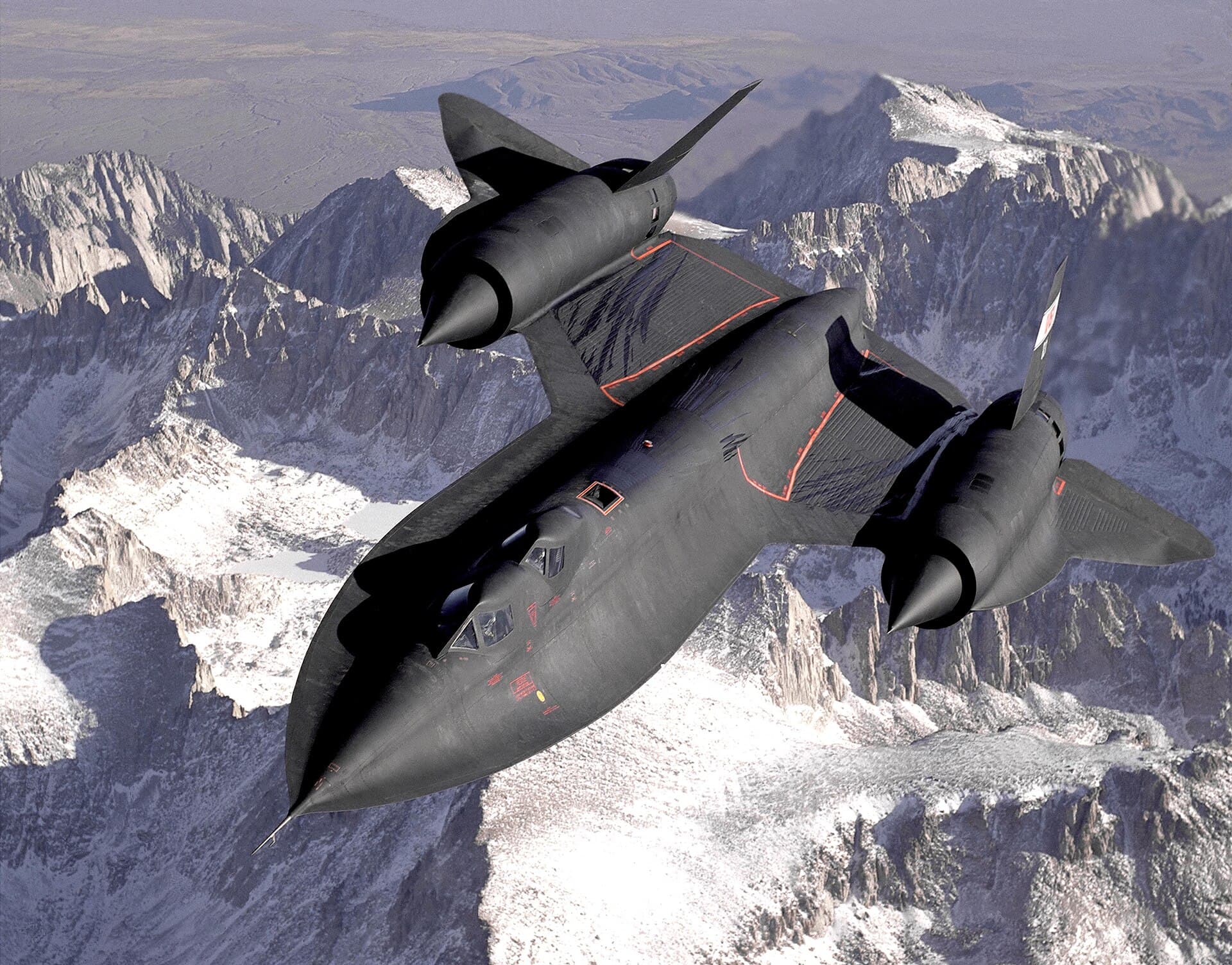
SR-71 Blackbird
“Habu”
Mach 3.2 at 85,000 feet, made of titanium, never once shot down.
The construction room · No. 01
Anatomy of the Blackbird
One continuous silhouette.
An extraordinary set of parts.
Lockheed SR-71 · Scale study
The complete aircraft
Bringing the Blackbird into view…
Loading the detailed aircraft and its textures.
Explore 10 assemblies
Start with the silhouette
Every surface has a purpose.
Turn the aircraft to follow the chines from the slender nose into the delta wing. Then separate the assemblies to inspect the inlet spikes, paired nacelles, canopies and undercarriage. Select a numbered part in the view or use the guide.
Aircraft model and textures by Emmanuel Baranger / FlightGear. Web conversion and interactive exhibit by Codex.
Exterior and simulator cockpit study with landing gear extended. Separation and forebody section are illustrative; engine internals are not reconstructed. The cockpit includes an adapted seat, as documented in the source notes. Engineering reference: Smithsonian and NASA.
History
After Powers was shot down in 1960, the U.S. needed a reconnaissance aircraft that could not be intercepted at all. The CIA's Project OXCART, begun in 1959, produced the A-12; the Air Force's slightly larger two-seat derivative became the SR-71. Kelly Johnson's team designed an aircraft that cruised — not dashed, cruised — above Mach 3 at 85,000 feet, faster than any missile of its era could sustain a chase.
Over 34 years of operations, SAM sites fired well over a thousand missiles at Blackbirds. None ever hit. Standard evasion procedure was simply to accelerate.
The aircraft mapped North Vietnam, the Middle East during the 1973 war, Libya during the 1986 strikes, and the Soviet periphery for a quarter century. Retired in 1990, briefly revived, retired finally in 1998–99; on its 1990 retirement flight to the Smithsonian, an SR-71 crossed the continental U.S. in 64 minutes.
Why it mattered
The Blackbird remains the fastest, highest-flying air-breathing production aircraft ever built — designed with slide rules in the early 1960s. It is the definitive proof-of-concept for the Skunk Works method: small teams, direct authority, ruthless prioritization, and problems solved from first principles because nothing off the shelf survived Mach 3.
Engineering breakdown
Airframe & structure
93% titanium alloy (B-120VCA) — at sustained Mach 3.2, skin temperatures exceed 500–600°F, beyond aluminum's limits. The airframe was built loose: corrugated wing skins and expansion joints let panels grow inches at temperature, which is why parked Blackbirds dripped fuel through their gaps. The chined forebody generates body lift and — discovered almost incidentally — scatters radar, making the Blackbird an accidental pioneer of stealth shaping.
Materials
Titanium tooling had to be reinvented: cadmium-plated tools embrittled the metal, chlorinated water etched it, so the Skunk Works rewrote its entire shop practice. The ore, in one of the Cold War's best ironies, was covertly sourced through third countries from the Soviet Union — the world's dominant titanium producer. Special JP-7 fuel with such low volatility that a lit match drops into it and goes out; engine start required a chemical ignition system (triethylborane, which ignites on contact with air).
Aerodynamics
Everything is shaped for sustained Mach 3.2 cruise: the delta wing, the blended chines (which contribute significant lift and stabilize the aircraft), and above all the propulsion integration — at cruise, most of the thrust comes from the inlets' pressure recovery rather than the engines themselves. It flew so hot that crews waited for the airframe to cool before touching it after landing.
Key innovations
- First titanium-primary-structure aircraft — new mills, tools, drills, and quality processes invented from scratch
- Movable-spike inlets managing the shock system from Mach 0 to 3.2+, automatically (after early 'unstarts' slammed crews' heads into canopies)
- JP-7 fuel doubling as hydraulic fluid and airframe coolant
- Radar cross-section shaping and iron-ferrite paint — practical stealth 15 years before the F-117
- Astro-inertial navigation tracking stars in daylight from a quartz window
Propulsion
2× Pratt & Whitney J58 (JT11D-20)
Pratt & Whitney · Afterburning turbojet with turbo-ramjet bleed-bypass cycle · 34,000 lbf each with afterburner
The J58's trick is the bleed-bypass cycle: above Mach 2.2, six large tubes bypass compressor air directly into the afterburner, converting the engine progressively into a ramjet — at Mach 3.2 cruise the turbomachinery contributes only a fraction of net thrust, with the inlet spike's compression and the afterburner doing most of the work. It was the first engine certified for continuous afterburner operation, ran on JP-7, and used the fuel as a heat sink for everything from oil to avionics before burning it. Recreating a J58 means recreating its whole thermal ecosystem — the inlet, the fuel, the materials — which is why nothing comparable has flown since.
Specifications
The people
Lore
The 'Blackbird' name came from the heat-shedding black ferrite paint Ben Rich championed; crews called it the Habu, after the Okinawan pit viper, once it deployed to Kadena.
Asked what he'd do about a SAM launch, one pilot answered: 'I'd just accelerate.' Over 1,000 missiles were fired at Blackbirds; all missed.
The LA Speed Check story — a Blackbird crew asking Los Angeles Center for a ground-speed readout after a Cessna and an F-18 had asked for theirs — is the most retold pilot story in American aviation.
On its final Smithsonian delivery flight (March 6, 1990), SR-71 #972 flew Los Angeles to Washington in 64 minutes 20 seconds.
Facts for the placard
- Titanium for the world's most secret American aircraft was covertly bought from the USSR.
- At cruise the airframe stretched several inches from thermal expansion; fuel sealing was only achieved at temperature.
- Crews wore full pressure suits — the same David Clark lineage as NASA astronauts — because a cabin loss at 85,000 ft is unsurvivable without one.
- No SR-71 was ever lost to enemy action in 34 years; 12 were lost to accidents.
Sources & further reading
- Smithsonian National Air and Space Museum — Lockheed SR-71 Blackbird
- CIA — declassified OXCART / A-12 program history
- NASA Armstrong — SR-71 fact sheet (research operations)
- Lockheed Martin — SR-71 Blackbird history
- Ben Rich & Leo Janos, 'Skunk Works' (Little, Brown, 1994) — primary participant memoir
- Photograph: U.S. Air Force photo by Judson Brohmer (public domain), via Wikimedia Commons.