Exhibit 11 · McDonnell Aircraft
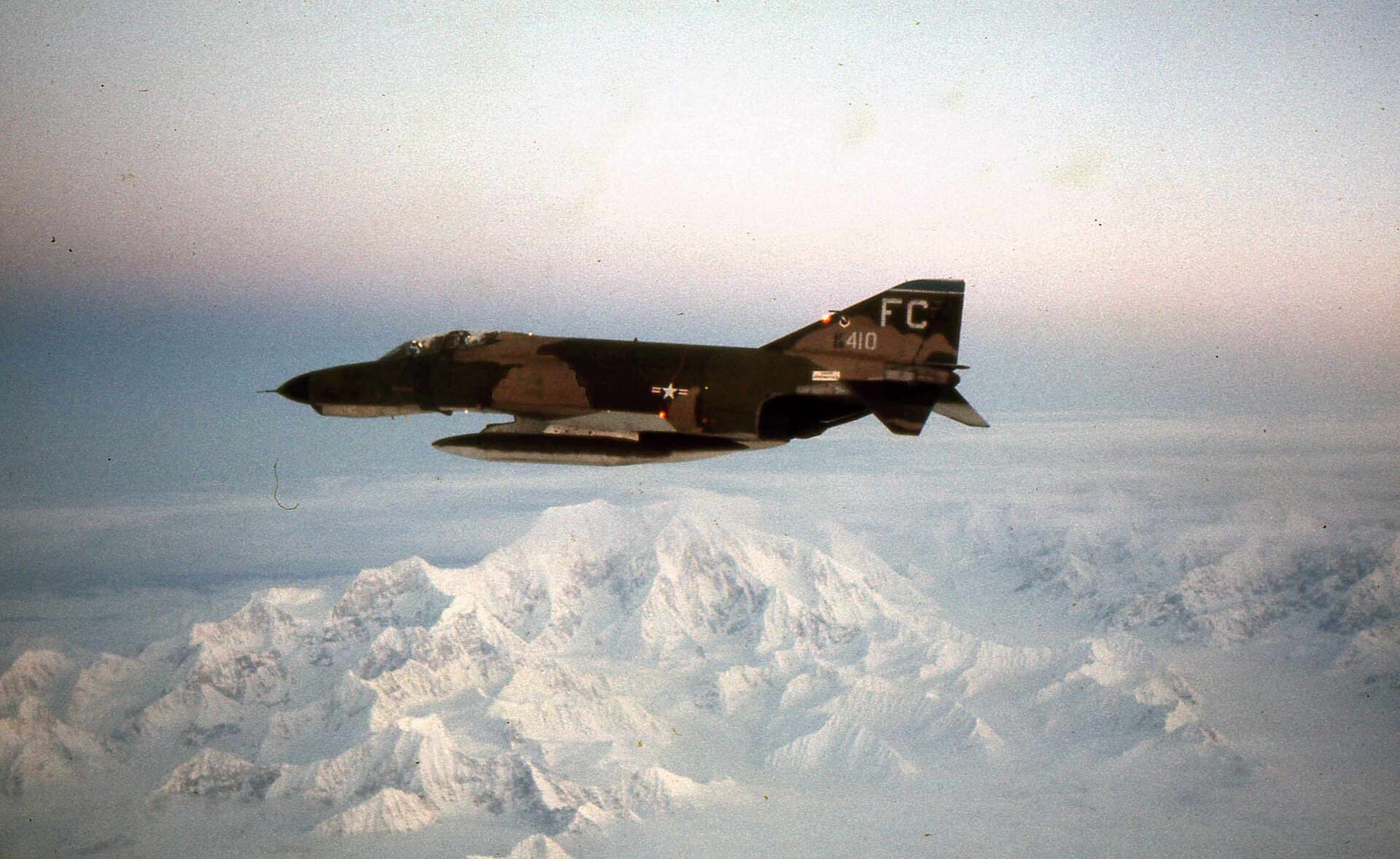
F-4 Phantom II
Brute force and twin J79s: the fighter that flew every mission in Vietnam.
History
McDonnell designed the Phantom as a missile-armed fleet-defense interceptor for the Navy — two engines, two crew, a big radar, and no gun, because missiles were the future. It was so overwhelmingly capable that the Air Force swallowed its pride and adopted a Navy fighter almost unchanged.
Over Vietnam the Phantom flew everything: MiG sweeps, bombing, reconnaissance, Wild Weasel SAM-hunting. The missiles-only doctrine failed against nimble MiG-17s and MiG-21s in visual-range fights — early AIM-7 Sparrows hit less than 10% of the time — forcing the addition of an internal M61 cannon on the F-4E and the founding of Top Gun and the USAF Fighter Weapons School.
It set 16 world records, including absolute speed (1,606 mph) and a 98,557-ft zoom-climb altitude record, and served with 11 nations. Both the Thunderbirds and Blue Angels flew it — the only aircraft both teams shared.
Why it mattered
The Phantom taught American air power its hardest modern lesson: technology does not repeal the dogfight. The gun's return, Top Gun's founding, and the energy-maneuverability theory that produced the F-15 and F-16 are all downstream of the Phantom's Vietnam experience.
Engineering breakdown
Airframe & structure
Twin J79s side by side, tandem crew, and a big low-mounted wing with 12° dihedral on the outer panels only — a fix discovered in testing, paired with 23° anhedral on the stabilators to keep roll and pitch stability without redesigning the wing center section. The result is the Phantom's unmistakable bent-wing, droop-tail silhouette.
Materials
Mostly conventional aluminum, but with titanium in the aft fuselage and keel around the engines — one of the earliest large-scale titanium applications in a production fighter — plus stainless steel around the afterburner bays.
Aerodynamics
Blown flaps (boundary-layer control using engine bleed air) tamed carrier approach speeds for an aircraft this heavy. The outboard wing leading edges got fixed slats (F-4E) after Vietnam experience demanded better turning; nothing about the Phantom is delicate — it substitutes thrust for finesse and it works.
Key innovations
- First fighter designed missiles-only (a lesson learned the hard way)
- Pulse-Doppler radar with a dedicated back-seat operator — the two-crew air-combat template
- Blown flaps enabling carrier operation at 25+ tons
- Early large-scale titanium hot-structure use in a production fighter
Propulsion
2× General Electric J79-GE-17
General Electric · Afterburning axial turbojet, variable stators · 11,905 lbf dry / 17,845 lbf afterburner, each
The same variable-stator J79 as the F-104, in a pair. Combined 35,690 lbf of afterburning thrust made the Phantom a rocket with wings — it could accelerate going straight up. The J79's visible black smoke trail at military power was its tactical flaw: MiG pilots spotted Phantoms miles away by the smoke, and crews learned to fly with one engine in minimum afterburner to run clean.
Specifications
The people
Lore
Its crews' motto: 'proof that with enough thrust, even a brick can fly.' McDonnell's mascot, the grinning 'Spook', is still painted on Phantoms worldwide.
Operation Bolo: Olds' Phantoms mimicked bomb-laden F-105 formations on radar; the MiGs that rose to intercept easy prey met air-superiority Phantoms instead. Seven MiG-21s down, zero losses.
Facts for the placard
- 5,195 built — no Western supersonic fighter has ever matched the number.
- Project LANA Phantoms crossed the U.S. in under 3 hours in 1961; 'Sageburner' set a low-altitude record of 902 mph at 125 ft.
- Iranian F-4s remain in combat service more than 65 years after the type's first flight.