Exhibit 10 · Convair
B-58 Hustler
A Mach 2 bomber of impossible beauty, obsolete the day it was perfect.
History
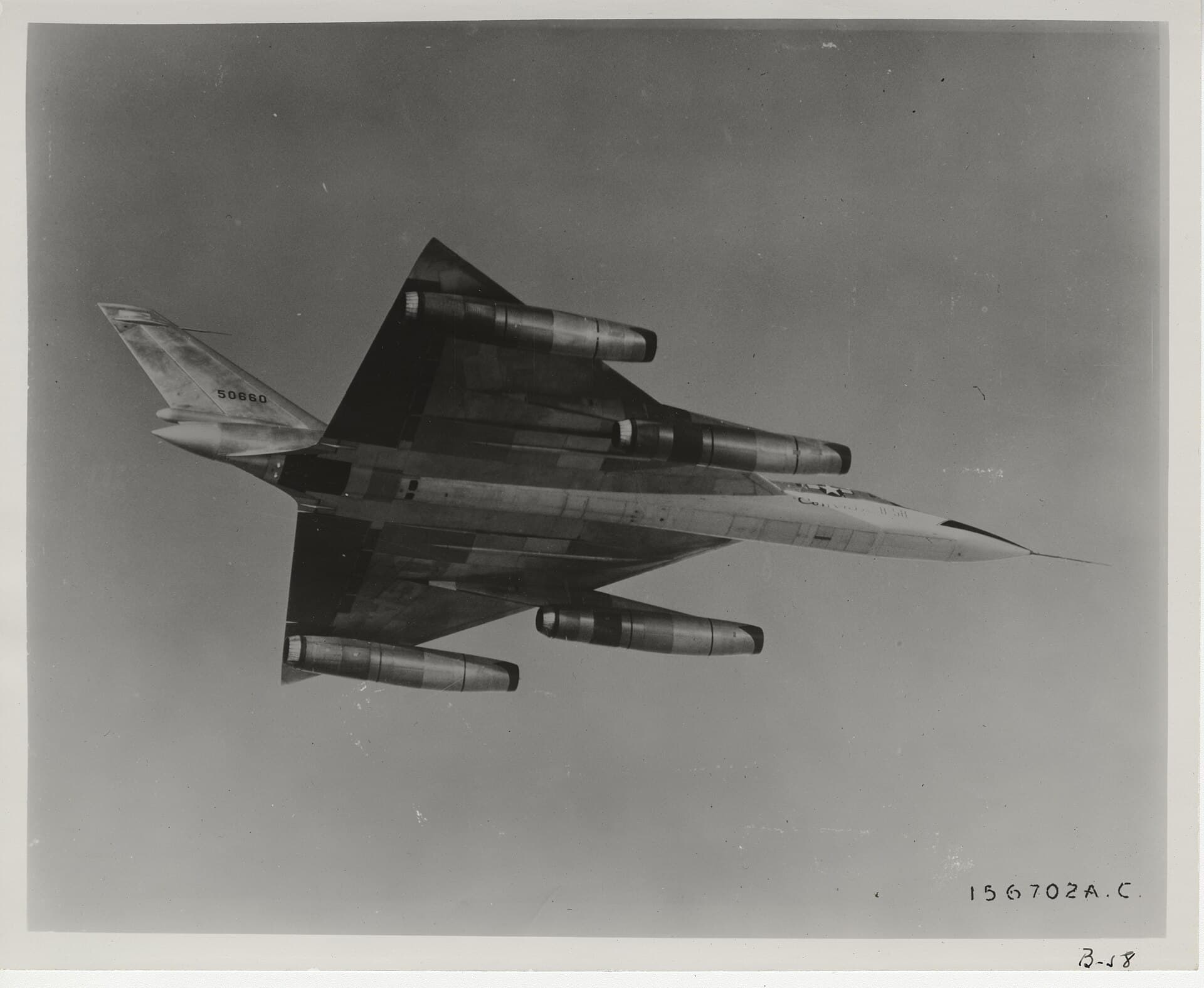
Convair took its delta-wing expertise from the F-102/F-106 interceptors and scaled it into the world's first supersonic strategic bomber: a slender area-ruled delta with four podded J79s and its entire war load — weapon and most of its fuel — in a huge jettisonable pod slung beneath the fuselage, because the airframe itself was too thin to hold either.
The Hustler set 19 world records — including Los Angeles to New York in 2 hours 56 seconds averaging over 1,200 mph — and collected the Bendix, Mackay, Harmon, and Thompson trophies. Crews loved and feared it: unforgiving at the edges, it killed 26 of the 116 built in accidents.
Its strategic logic evaporated almost instantly. Designed to penetrate at Mach 2 and 60,000 feet, it was rendered obsolete by the same SA-2 missile that downed Powers' U-2 in 1960; SAC retrained crews for low-level penetration, where the B-58's fuel burn and structural life collapsed. It retired after just ten years — a $3 billion sculpture of a strategy that lasted one procurement cycle.
Why it mattered
The B-58 is the museum's cautionary placard: engineering brilliance in service of an assumption (high-and-fast penetration) that a $30,000 missile falsified. Its real legacies are technical — area-rule at bomber scale, the first airborne stellar-inertial navigation, honeycomb structure — and doctrinal: after the Hustler, American bombers went low (F-111, B-1) or invisible (B-2), never again merely fast.
Engineering breakdown
Airframe & structure
A 60° delta wing blended with a Coke-bottle area-ruled fuselage — Richard Whitcomb's transonic-drag discovery applied at full bomber scale. The structure was skinned in bonded aluminum-honeycomb sandwich panels — thin skins over hexagonal core — pioneering the lightweight-stiff construction later universal in aerospace. Crew of three in tandem, each in an individual ejection capsule that enclosed the occupant before firing — tested successfully by a bear.
Materials
Aluminum honeycomb sandwich over most of the wetted surface, with stainless steel honeycomb in the hottest zones near the engines — a manufacturing gamble that taught the industry adhesive bonding at scale.
Aerodynamics
The area rule dictates that cross-sectional area change smoothly nose-to-tail; the B-58's pinched waist and podded engines follow the equation almost literally. With no flaps on a 60° delta, takeoff and landing speeds were fierce, and at Mach 2 the aircraft rode on precisely scheduled inlet spikes ahead of each J79.
Key innovations
- First supersonic (Mach 2) strategic bomber
- Area-ruled fuselage at bomber scale
- Bonded honeycomb sandwich structure as primary airframe construction
- First airborne stellar-inertial navigation system (tracking stars through a dome by day)
- Encapsulated ejection seats rated to Mach 2 at 70,000 ft
Propulsion
4× General Electric J79-GE-5A
General Electric · Afterburning axial turbojet, variable stators · 15,600 lbf each with afterburner
The ubiquitous J79 again — the B-58 hung four of Gerhard Neumann's variable-stator engines in individual underwing pods on the F-104/F-4's powerplant. Sustained Mach 2 cruise in afterburner drank fuel so fast that the mission depended on the centerline pod's tanks, burned first and dropped with the weapon. The four-pod delta layout made the Hustler a familiar silhouette to every engineer who later worked supersonic transport studies — Concorde's configuration owes it a quiet debt.
Specifications
The people
Lore
Convair tested the ejection capsules by firing black bears out of a B-58 at supersonic speed; the bears survived, sedated and indignant, and the capsules were certified.
On the 1962 transcontinental record run, the crew outpaced the earth's rotation — landing in New York at a local time barely three hours after leaving Los Angeles — and collected a $1 bet with operations that they couldn't beat three hours.
SAC crews called the pod-less ferry configuration 'clean' — and a clean Hustler, stripped of its pod, was reportedly capable of edging past its official numbers.
Facts for the placard
- 19 world speed and altitude records in a decade of service.
- 26 of 116 aircraft were lost in accidents — the price of operating at the 1960 state of the art.
- The stellar-inertial navigator worked out position from star sightings in daylight — the same approach the SR-71 refined a decade later.
Sources & further reading
- National Museum of the USAF — Convair B-58A Hustler fact sheet
- NASA — Richard Whitcomb and the area rule (NASA History)
- Lockheed Martin (Convair heritage records) — B-58 program history
- Photograph: A Convair B-58 Hustler in flight without its centerline weapons-fuel pod. U.S. Air Force photo (public domain), via Wikimedia Commons.