Exhibit 09 · North American Aviation
North American X-15
The fastest piloted aircraft ever flown: Mach 6.7, and to the edge of space.
History
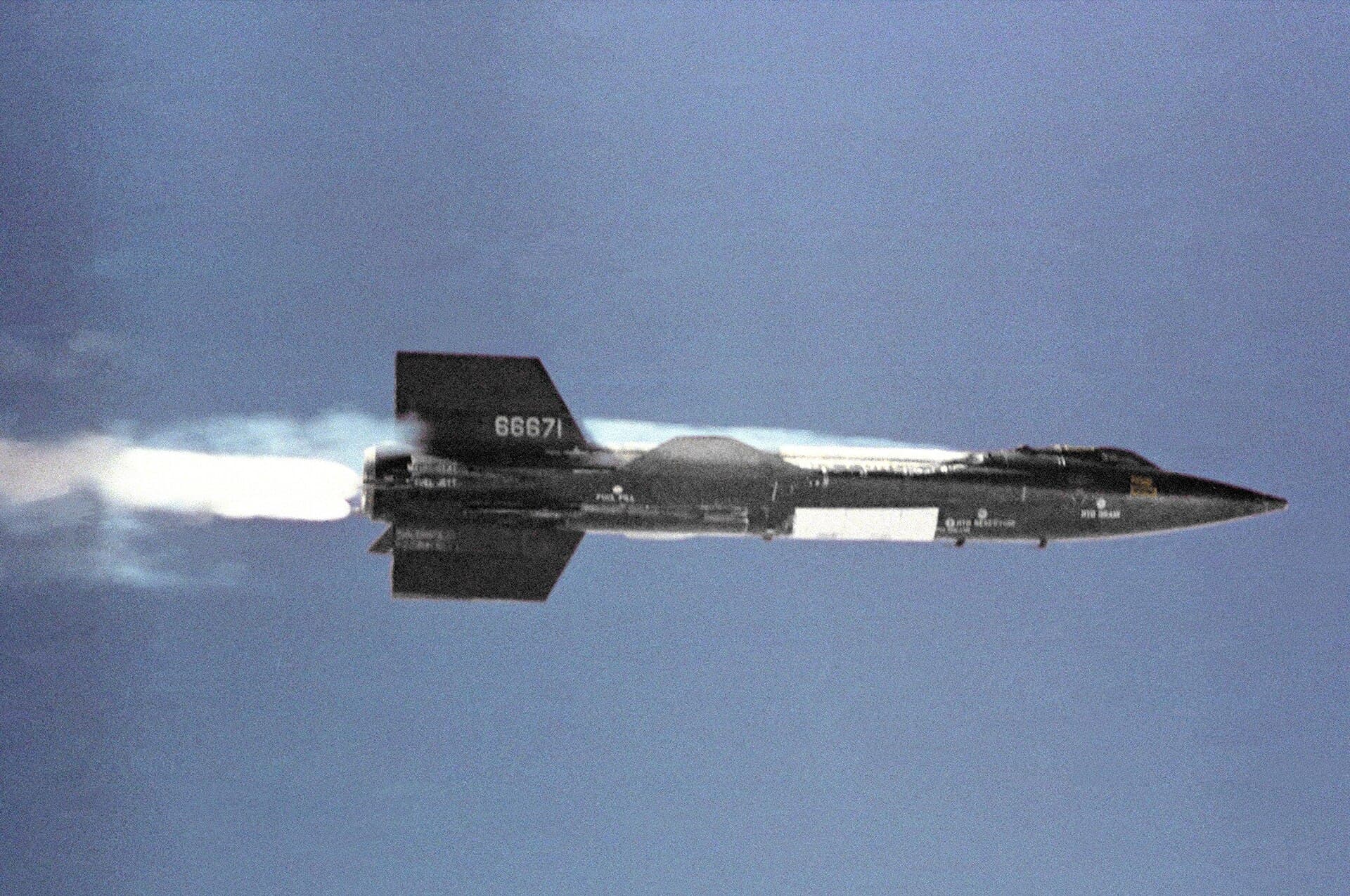
Conceived in 1954 to answer questions no wind tunnel could: what happens to a piloted aircraft, its structure, and its pilot at hypersonic speed and in space-equivalent flight? Air-launched from a B-52's wing pylon over the Mojave, the X-15 burned its rocket engine for about 85 seconds, then flew home as history's fastest glider.
Between 1959 and 1968 three airframes flew 199 missions. On October 3, 1967, Pete Knight flew X-15A-2 to Mach 6.7 (4,520 mph) — still the piloted aircraft record. Thirteen flights exceeded 50 miles altitude, earning eight pilots astronaut wings; Joe Walker twice passed the 100 km Kármán line.
X-15 data underwrote Mercury, Gemini, Apollo, and the Space Shuttle: hypersonic aerodynamics, reaction controls, pilot workload in space, lifting reentry, thermal structures. Michael Adams died on Flight 191 in 1967 when the aircraft entered a hypersonic spin — the program's only fatality.
Why it mattered
The X-15 is the bridge between airplanes and spacecraft. Nearly every reentry-vehicle design decision of the 1960s–70s could point to an X-15 flight for validation — a research return unmatched by any flight program before or since.
Engineering breakdown
Airframe & structure
A missile-shaped fuselage with stubby wings and wedge-section vertical tails. The lower ventral fin was jettisoned before landing to let the skids touch down. Flight controls switch regimes: aerodynamic surfaces in the atmosphere, hydrogen-peroxide reaction thrusters in space, blended through pioneering adaptive flight-control systems.
Materials
Skinned in Inconel X, a nickel-chromium superalloy that keeps its strength at the 1,200°F+ generated by hypersonic friction — aluminum would have softened and failed. For the Mach 6.7 flights, X-15A-2 wore an ablative coating (MA-25S) over the Inconel plus external tanks; even so, shock interaction heating nearly burned through the ventral fin pylon on the record flight.
Aerodynamics
Hypersonic stability came from the wedge-shaped tails — counterintuitively blunt trailing edges that stay effective when shock waves dominate the flow. Reentry from 350,000 ft was flown at 20°+ angle of attack under 5g, exactly the profile the Shuttle would later fly.
Key innovations
- First application of reaction-control thrusters blended with aerodynamic controls — direct ancestor of every spacecraft RCS
- Inconel X hot structure — accepting heat into a superalloy skin rather than insulating against it
- The MH-96 adaptive flight control system (X-15-3) — an early fly-by-wire gain-scheduling controller
- Full-pressure suits developed for X-15 pilots became the basis of early NASA spacesuits
Propulsion
Reaction Motors XLR99-RM-2
Reaction Motors (Thiokol) · Throttleable liquid rocket — anhydrous ammonia + liquid oxygen, turbopump-fed · 57,000 lbf (throttleable 50–100%)
The first large man-rated, throttleable, restartable rocket engine — capabilities taken for granted now that were unprecedented in 1959. The turbopump ran on hydrogen peroxide decomposition. At full power the XLR99 burned its entire 15,000-lb propellant load in under 90 seconds, accelerating the aircraft at up to 4g. Every large throttleable engine since — including SpaceX's — solves the same combustion-stability-across-throttle problem the XLR99 solved first.
Specifications
The people
Lore
Neil Armstrong's 1962 'bounce' off the atmosphere took him, unpowered, nearly to Pasadena before he stretched the glide back to Edwards — fellow pilots ribbed him for years.
After the Mach 6.7 flight, X-15A-2's ablator was scorched through and the ventral pylon partially melted; the aircraft never flew again. Nobody has flown faster in an airplane since 1967.
Facts for the placard
- 8 X-15 pilots earned astronaut wings; the aircraft reached space 13 times.
- The X-15 was air-dropped from a B-52 at 45,000 ft — the same B-52s later used to launch lifting bodies and the X-43.
- Program data directly shaped the Space Shuttle's reentry profile and thermal design.