Exhibit 08 · Lockheed (Skunk Works)
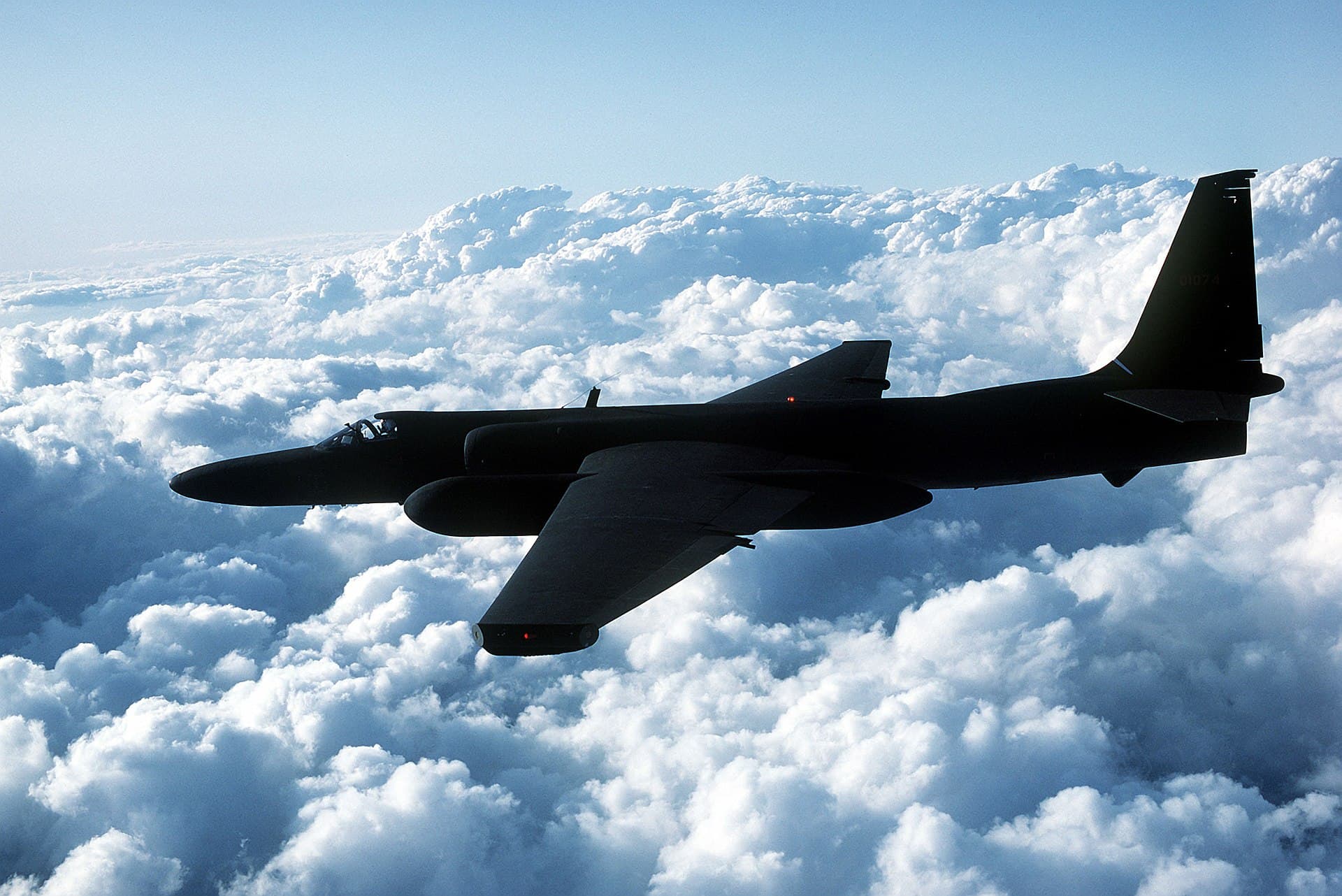
U-2 Dragon Lady
A jet-powered glider built in secret in eight months to look down on the Soviet Union.
History
In 1954 the U.S. was essentially blind to Soviet bomber and missile programs. Kelly Johnson promised the CIA an aircraft that could cruise above 70,000 feet — beyond every interceptor and missile of the day — and deliver it in eight months. Project AQUATONE was approved in December 1954; article 341 flew from the secret Groom Lake test site (a location the Skunk Works itself selected) on August 1, 1955.
From 1956 to 1960, CIA U-2s overflew the USSR with impunity, photographing bomber bases and missile sites and disproving the 'bomber gap'. On May 1, 1960, an SA-2 salvo brought down Francis Gary Powers over Sverdlovsk — a diplomatic earthquake that ended Soviet overflights and accelerated both the SR-71 and reconnaissance satellites.
In October 1962 a U-2 photographed Soviet missiles in Cuba, triggering the Cuban Missile Crisis; Major Rudolf Anderson was shot down during the crisis, its only combat casualty. Continuously modernized, the U-2S still flies operational missions today.
Why it mattered
The U-2 gave presidents hard photographic intelligence in place of guesswork — arguably no aircraft ever produced more strategic value per airframe. Its eight-month development remains the canonical proof of what a small, trusted, unbureaucratic engineering team can do.
Engineering breakdown
Airframe & structure
Essentially a jet-powered sailplane: 80-foot high-aspect-ratio wings on a slender fuselage derived from the F-104's tooling. Structure built to 2.5g — half a fighter's strength — to save every pound. Bicycle landing gear with jettisonable outrigger 'pogos'; every landing ends balanced on two wheels, with a chase car calling out altitude.
Materials
Thin-gauge aluminum throughout, machined and skinned to sailplane weights. The wings hold fuel in integral wet-wing tanks; gross weight was so critical that Johnson's team weighed everything, including the paint.
Aerodynamics
At cruise above 70,000 ft the U-2 flies in the 'coffin corner': stall speed and critical Mach number converge to within about 10 knots. Fly too slow and it stalls; too fast and shock-induced buffet begins. Pilots hand-flew inside that band for hours in pressure suits.
Key innovations
- Sustained flight above 70,000 ft in 1955 — a decade ahead of any adversary's reach
- 2.5g lightweight structure: performance bought with structural discipline, not engine power
- Special low-vapor-pressure JP-7 precursor fuel (LF-1A) that would not boil off at altitude
- Camera systems (Hycon B) resolving 2.5-ft objects from 13 miles up
Propulsion
Pratt & Whitney J57-P-37A (original) → GE F118-GE-101 (U-2S)
Pratt & Whitney / General Electric · Twin-spool axial turbojet → non-afterburning turbofan · 11,200 lbf (J57) → 17,000 lbf (F118)
The J57 — the first 10,000 lbf-class production engine, with its innovative twin-spool layout — was specially modified to relight and run in air so thin most engines flame out. The twin-spool arrangement (two concentric shafts turning at different speeds) solved compressor mismatch across the huge density range from sea level to 70,000+ ft. The modern U-2S flies on the F118 turbofan, a derivative of the B-2's engine.
Specifications
The people
Lore
Kelly Johnson picked the dry lakebed at Groom Lake, Nevada, as the test site — the U-2 program is why 'Area 51' exists.
To hide its purpose, the aircraft was designated U for 'Utility' and cover-storied as a NASA weather research plane — the cover NASA had to awkwardly maintain for days after Powers was shot down.
U-2 pilots lose weight on every flight; they breathe pure oxygen for an hour before takeoff and eat tube food through their helmets on 12-hour missions.
Facts for the placard
- The program came in $3.5 million under budget — Johnson returned the money.
- Landing requires a chase car (typically driven by another U-2 pilot) radioing the height above the runway, because the pilot in the pressure suit cannot see it.
- The U-2 has outlived its own successor: the SR-71 retired in 1999, while U-2s still fly today.