Exhibit 07 · Lockheed
C-130 Hercules
Seventy years in production, and the design brief was simply: be useful.
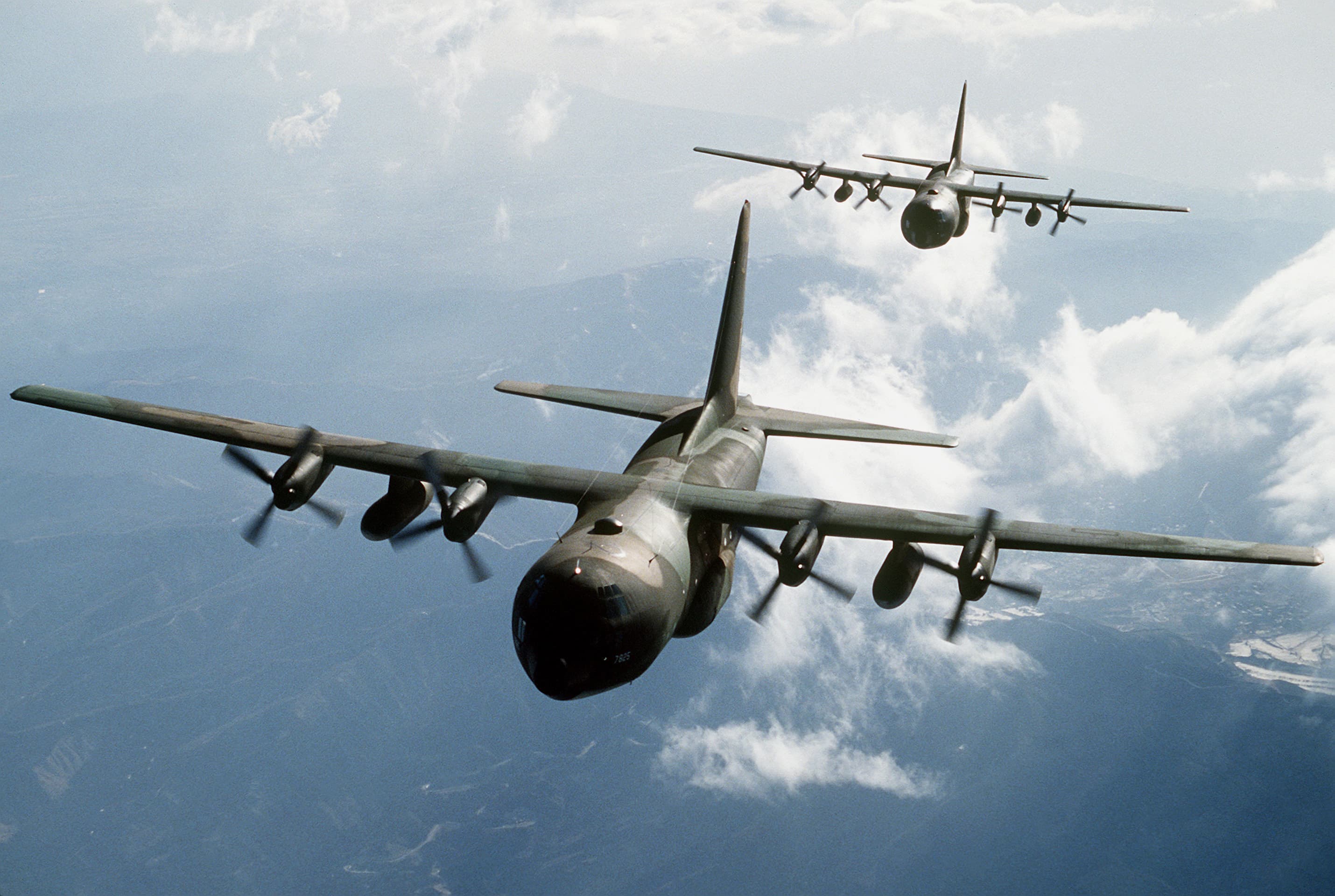
History
Korea exposed the absurdity of hauling modern armies with WWII transports. The 1951 requirement asked for something unglamorous: carry 92 infantry or 15,000 pounds, take off from short dirt strips, fly with one engine out, and load vehicles straight in the back. Lockheed's answer was so unstylish that Kelly Johnson — of all people — reportedly argued against submitting it, fearing the frumpy design would embarrass the company.
The frumpy design became the most enduring aircraft in military history. High wing, low unpressurized-height cargo floor at truck-bed level, full-width rear ramp, rough-field gear in external blisters: every subsequent tactical airlifter in the world is a variation on this layout.
Hercules have flown every mission an airframe can be assigned: assault landings at Khe Sanh, the Entebbe raid (Israeli C-130s), Antarctic ski operations (LC-130), hurricane hunting (WC-130), gunship duty (the AC-130, orbiting artillery with a 105mm howitzer aboard), aerial firefighting, and carrier landings — a KC-130F landed and took off from USS Forrestal in 1963 without arresting gear, unassisted.
Why it mattered
The C-130 is the counter-argument to every other exhibit in this museum: no speed record, no exotic material, no radar trickery — just a correctly-framed requirement answered with total honesty. The result has outlived every glamorous contemporary and remains in production after 70 years. Engineering longevity, it turns out, comes from solving the right problem.
Engineering breakdown
Airframe & structure
High-mounted straight wing over a fat, flat-floored fuselage; the cargo deck sits 40 inches off the ground — truck-bed height — with a rear ramp that doubles as an airdrop platform. Landing gear retracts into external fuselage blisters, sacrificing streamlining so the cargo bay stays an uninterrupted box.
Materials
Conventional aluminum, over-built for rough-field abuse — the machined-plank wing skins introduced on the C-130 were an early production use of large integrally-stiffened machined panels.
Aerodynamics
A thick, high-lift straight wing and huge Fowler flaps buy short-field performance: a loaded Hercules can be off the ground in under 1,500 feet with JATO assistance. Nothing about it is fast — and nothing about it needed to be. Reverse-pitch propellers back it out of tight ramps and shorten landings to attack-strip lengths.
Key innovations
- Truck-bed-height cargo floor with drive-on rear ramp — now the universal airlifter formula
- Turboprop power on a production transport when contemporaries were choosing pistons or thirsty jets
- LAPES (Low-Altitude Parachute Extraction): delivering tanks from five feet without landing
- Platform versatility — gunship, tanker, hurricane hunter, ski-bird, drone controller — from one unchanged cross-section
Propulsion
4× Allison T56-A-15 (legacy) → Rolls-Royce AE 2100D3 (C-130J)
Allison / Rolls-Royce · Single-shaft turboprop → dual-FADEC turboprop with 6-blade composite props · 4,590 shp each (T56) → 4,637 shp (AE 2100)
The T56 is the quiet giant of American propulsion: a constant-speed single-shaft turboprop (the propeller governs at 100% RPM always; power changes via fuel and blade pitch) that has run since 1954 with over 18,000 built, also powering the P-3 and E-2. Turboprops trade jet speed for propulsive efficiency at low altitude and speed — exactly the airlifter's regime. The C-130J's AE 2100 with scimitar six-blade composite props cut fuel burn ~15% and turned the J-model into effectively a new aircraft wearing the old silhouette.
Specifications
The people
Lore
In 1963, Lt. James Flatley landed a 85,000-lb KC-130F on the carrier Forrestal 21 times — no hook, no catapult — proving the Herk could resupply carriers at sea. The Navy concluded it worked and was far too alarming to operationalize.
At Khe Sanh in 1968, C-130s delivered under mortar fire using LAPES — streaming pallets from five feet — after the runway became too dangerous to stop on.
The AC-130 gunship orbits a point on the ground firing sideways — the descendant of a 1927 barnstormer's trick of lariat-dropping mail bags from a pylon turn.
Facts for the placard
- The C-130 has been in continuous production longer than any military aircraft in history — over 70 years on the same Marietta line.
- One airframe type performs airlift, gunship, tanker, weather reconnaissance, Antarctic ski operations, firefighting, and special-operations infiltration.
- More than 70 nations operate or have operated the Hercules.