Exhibit 06 · Lockheed (Skunk Works)
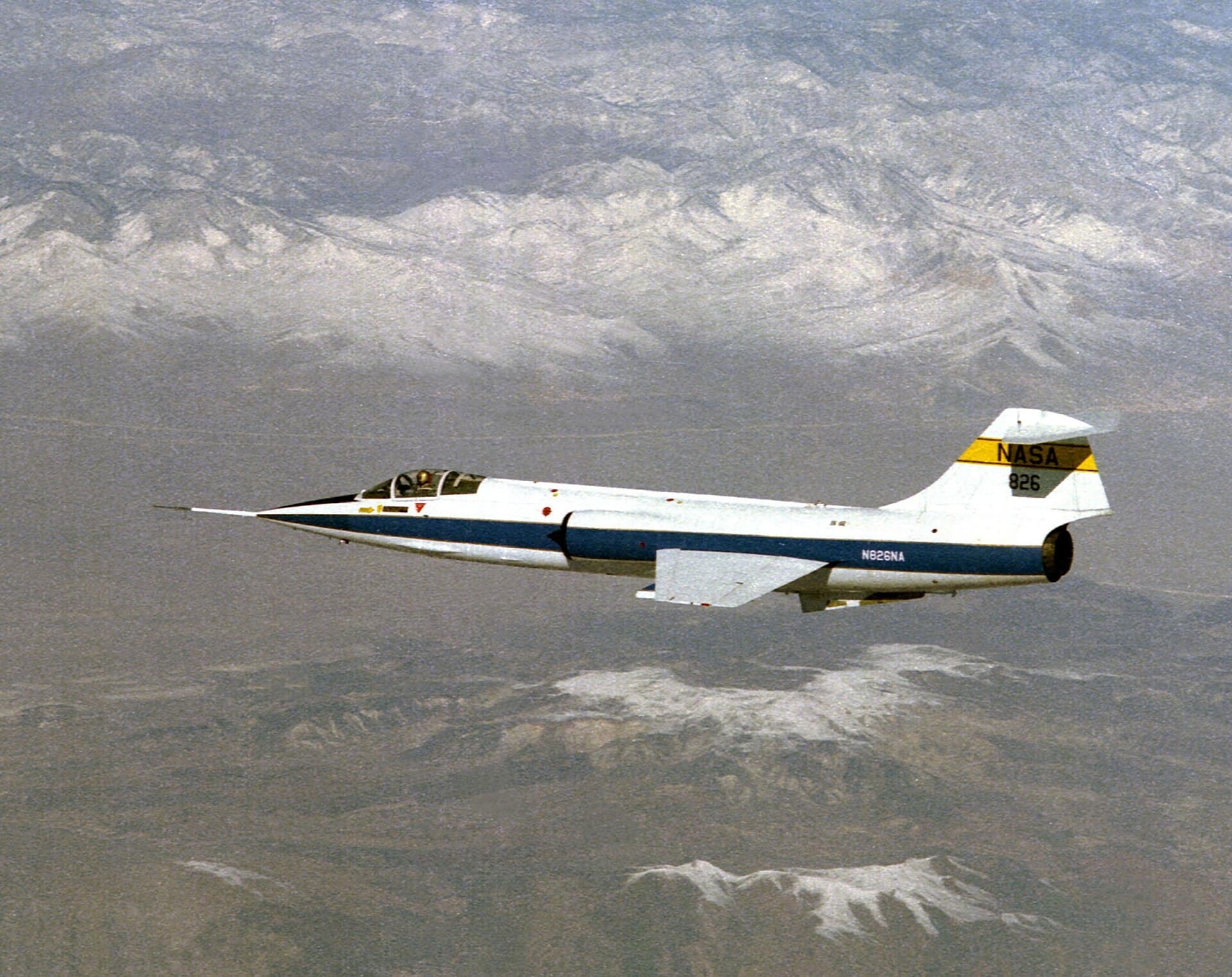
F-104 Starfighter
“The Missile with a Man in It”
Kelly Johnson's answer to one question: how fast can a fighter possibly go?
History
In 1952 Kelly Johnson toured Korea interviewing fighter pilots. Their message: stop giving us heavy, complicated airplanes — give us speed and altitude. Johnson returned and designed the most extreme answer imaginable: the smallest possible airframe wrapped around the biggest available engine.
The F-104 was the first fighter to hold the world speed and altitude records simultaneously, and the first to fly at sustained Mach 2. In USAF service it was brief — its short range and unforgiving handling fit poorly with actual missions — but it found a second life as NATO's standard strike fighter, built under license in Germany, Italy, Japan, Canada, and Belgium.
Germany's fleet suffered nearly 300 losses, earning the grim nickname 'Witwenmacher' (widow-maker) — less the airplane's fault than the result of flying a fair-weather interceptor at low level in European weather.
Why it mattered
The Starfighter marks the outer limit of the pure-speed philosophy of 1950s fighter design — and its NATO production program was the largest industrial aviation collaboration of its era, seeding Europe's postwar aerospace industry.
Engineering breakdown
Airframe & structure
A 54-foot needle fuselage with tiny trapezoidal wings spanning just 21 feet. The wing is biconvex — a supersonic airfoil so thin (3.36% thickness, 7.5 ft chord) that its leading edge, at 0.016 inch radius, was genuinely sharp; ground crews fitted felt covers to prevent injuries.
Materials
Aluminum structure, but with the wing machined from solid billets rather than built up from sheet — thin supersonic wings can't house conventional spar-and-rib construction. Fuel, gear, and armament all live in the fuselage.
Aerodynamics
The T-tail keeps the stabilizer out of the wing wake at supersonic speed but creates a vicious pitch-up at high angle of attack — the F-104 pioneered the stick shaker/kicker to stop pilots from entering it. Boundary-layer control blows engine bleed air over the flaps to bring landing speeds down to merely very fast.
Key innovations
- First operational Mach 2 fighter
- Downward ejection seat initially (to clear the T-tail) — later replaced by an upward-firing seat pilots trusted more
- Boundary-layer control flaps — engine bleed air re-energizes airflow to cut landing speed
- First fighter with the M61 Vulcan 20mm rotary cannon
Propulsion
General Electric J79-GE-11A
General Electric · Afterburning axial turbojet with variable stator vanes, 17-stage compressor · 10,000 lbf dry / 15,600 lbf afterburner
Gerhard Neumann's variable-stator compressor is the J79's genius: rows of stator vanes pivot with engine speed, letting a single spool achieve a 12.9:1 pressure ratio without stalling — previously thought to require heavy twin-spool designs. The J79 powered the F-104, F-4, B-58, and Israel's Kfir; over 17,000 were built. Its distinctive smoke trail and afterburner shriek made it the sound of the 1960s Air Force.
Specifications
The people
Lore
Pilots called it 'the missile with a man in it'. The Luftwaffe called it the 'Witwenmacher'. Chuck Yeager's NF-104 crash from the edge of space is its most famous single flight.
The wing's leading edge was sharp enough to cut — maintenance crews hung felt protectors on it in the hangar.
Facts for the placard
- On May 7, 1958, an F-104 held the world speed (1,404 mph) and altitude (91,243 ft) records at the same time — a first.
- NASA flew F-104s as chase and astronaut-trainer aircraft for over 30 years; Joe Walker's F-104 flew chase for the X-15.
- Italy retired the last military Starfighters in 2004 — a half-century after first flight.