Exhibit 05 · North American Aviation
F-100 Super Sabre
“The Hun”
The first fighter to go supersonic on the level — and the first to teach the price.
History
North American pitched the 'Sabre 45' — an F-86 with 45° of sweep — as the logical next step, and the Air Force, at war in Korea, wanted it immediately. The YF-100 exceeded Mach 1 on its maiden flight in May 1953, and the type entered service barely a year later: the first operational aircraft in the world capable of supersonic speed in level flight.
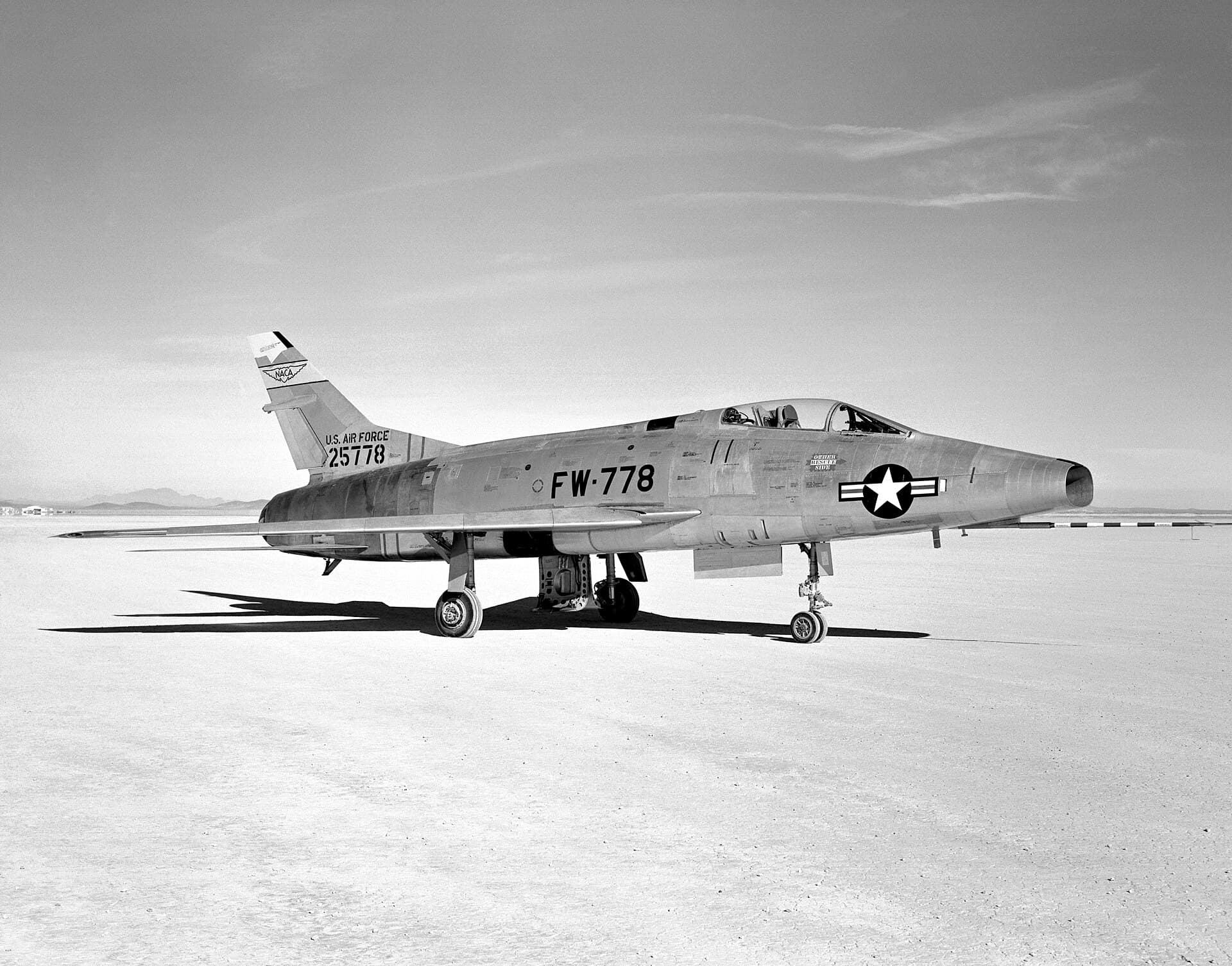
The rush collected its debt. The original short-tailed F-100A suffered inertia coupling and yaw divergence; a series of fatal crashes — including the one that killed North American's chief test pilot George Welch in October 1954 — grounded the fleet and forced a taller tail and wider wingtips. The redesigned aircraft matured into a solid fighter-bomber.
In Vietnam the 'Hun' became the workhorse of close air support, flying more sorties than the P-51 had flown in World War II. It also pioneered the Wild Weasel mission — two-seat F-100Fs deliberately baiting SAM radars so they could be killed — arguably the most dangerous job in the air war. The Thunderbirds flew it for over a decade.
Why it mattered
The F-100 opened the Century Series — the exuberant, occasionally reckless 1950s sprint in which each new American fighter leapfrogged the last by half a Mach number. It carried supersonic flight from a research stunt to a daily squadron event, and its early accidents taught the discipline (inertia coupling analysis, stability augmentation) that later designs were built on.
Engineering breakdown
Airframe & structure
A 45°-swept low-tail configuration with the first production application of titanium in quantity (about 10% of structural weight, in the hot aft fuselage). The one-piece all-moving 'slab' stabilizer — the F-86's flying tail taken to its conclusion — sat low, below the wing wake, a lesson written in the F-100A's accident record.
Materials
Aluminum primary structure with titanium aft fuselage panels around the afterburner — the first meaningful titanium tonnage on any production aircraft, a full decade before the Blackbird made the metal famous.
Aerodynamics
The 45° sweep bought level-flight supersonic speed but at low speed produced vicious behavior: at high angle of attack the swept wing's tips stalled first, pitching the nose further up. The resulting 'Sabre Dance' — an F-100 hanging on its afterburner in a nose-high stagger it could not fly out of — killed pilots throughout the type's life and was captured in one of the most sobering films in aviation safety history.
Key innovations
- First operational level-flight supersonic fighter
- First substantial production use of titanium
- Wild Weasel: the anti-SAM mission invented on two-seat F-100Fs in 1965
- First buddy-refueling (probe-and-drogue between fighters) in operational use
Propulsion
Pratt & Whitney J57-P-21A
Pratt & Whitney · Twin-spool axial turbojet with afterburner · 10,200 lbf dry / 16,000 lbf afterburner
The J57 was the pivotal American engine of the 1950s — the first production engine past 10,000 lbf, its twin-spool layout (separate low- and high-pressure shafts) solving the compressor-matching problem that had capped pressure ratios. It powered the F-100, F-102, F-8, U-2, B-52, and the 707's ancestors; 21,000 were built. The afterburning version gave the Hun its level-supersonic dash; the dry version lifted the U-2 into the stratosphere. One engine family, three exhibits in this museum.
Specifications
The people
Lore
The 'Sabre Dance' film of Barty Brooks' fatal 1956 approach — the F-100 balancing nose-high on its afterburner down the runway — became mandatory viewing for generations of pilots.
Misty FACs flew low and fast over the most heavily defended terrain in Vietnam; of 157 Misty pilots, 34 were shot down. Two later wore four stars; one, Bud Day, wore the Medal of Honor.
Facts for the placard
- First flight and first supersonic flight were the same flight.
- F-100s flew 360,283 combat sorties in Vietnam — more than any other USAF fighter.
- The Thunderbirds flew the F-100 from 1956 to 1968, longer than any other mount until the F-16.
Sources & further reading
- National Museum of the USAF — North American F-100D fact sheet
- NASA — F-100 variable-stability research (NASA History)
- Boeing (North American heritage) — F-100 Super Sabre
- Photograph: NACA's F-100A Super Sabre on Rogers Dry Lake, Edwards, mid-1950s. NACA/NASA photo (public domain), via Wikimedia Commons.