Exhibit 04 · Boeing
B-52 Stratofortress
“BUFF”
The bomber designed in a hotel room that will fly for a century.
History
Boeing's original 1946 proposal was a straight-wing turboprop. The Air Force kept rejecting it. In October 1948, Boeing's team — including George Schairer, who had cabled the German swept-wing data home from the Braunschweig labs in 1945 — was told at Wright Field to come back with a jet. Over a single weekend in the Van Cleve Hotel in Dayton, they redesigned the aircraft around eight turbojets and a 35° swept wing, carved a balsa model, and delivered a 33-page proposal on Monday. That airplane is, in outline, the B-52 that flies today.
It became the backbone of Strategic Air Command's nuclear deterrent, flying airborne-alert missions through the deepest Cold War. Over Vietnam it flew Arc Light and Linebacker II conventional strikes; over Iraq and Afghanistan it became a precision close-air-support platform, loitering with JDAMs.
Re-engining with Rolls-Royce F130s (the B-52J program) is intended to keep the airframe flying past its 100th birthday.
Why it mattered
No other combat aircraft has remained in frontline service so long. The B-52 proved that a sound structure with margin for growth outlives any particular technology cycle — its longevity is an argument for designing airframes as platforms rather than point solutions.
Engineering breakdown
Airframe & structure
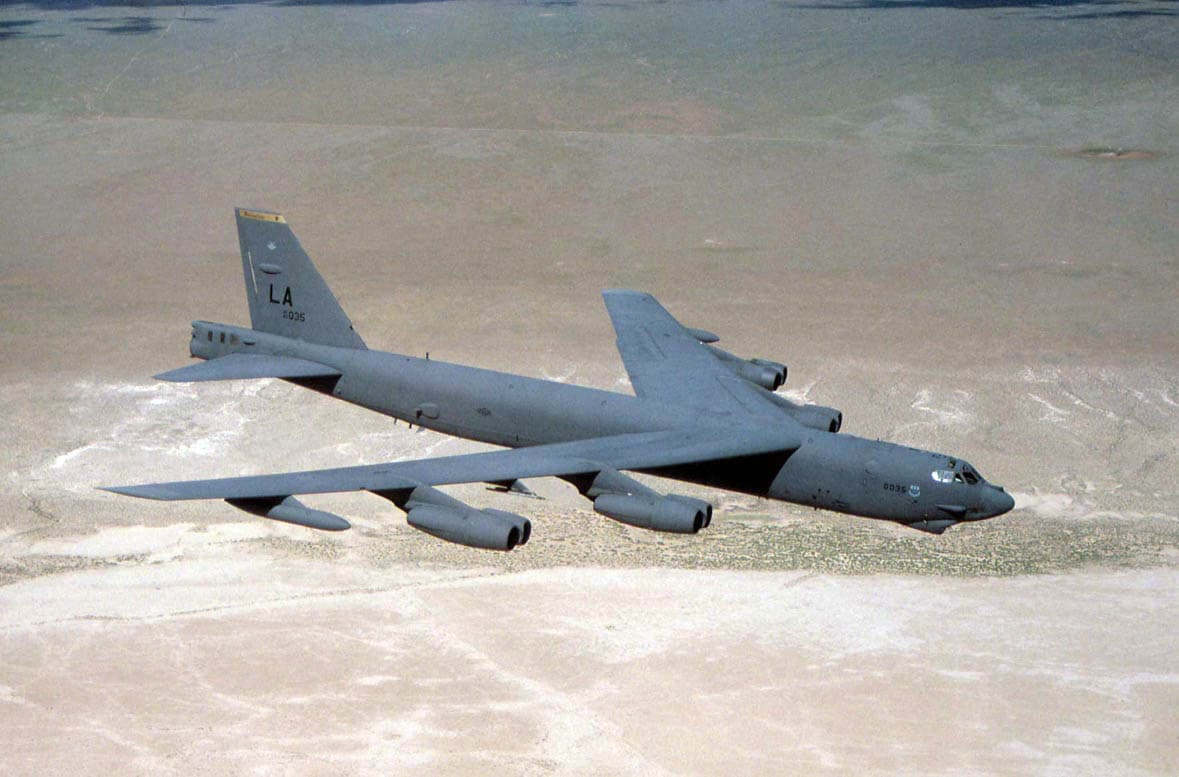
High-mounted, 35°-swept wing with enormous span (185 ft) and pronounced flex — wingtips can move nearly 25 feet between rest and full lift. Bicycle main landing gear in the fuselage with outrigger wheels near the wingtips; the main gear can crab up to 20° for crosswind landings, so the bomber lands pointed into the wind while rolling straight down the runway.
Materials
1950s aluminum alloys, over-built by modern standards — which is exactly why it survives. Decades of structural monitoring, skin replacements, and spar reinforcements have kept fatigue life ahead of the flying schedule.
Aerodynamics
The flexible high-aspect-ratio wing is closer to an airliner's than a fighter's: efficiency and range were the design drivers. Eight engines in four twin pods leave the wing aerodynamically clean and provide engine-out redundancy no four-engine layout matches.
Key innovations
- Crosswind ('crab') landing gear — unique among large aircraft
- Water injection for takeoff thrust on early variants
- Structural margin that has absorbed 70 years of new missions, radars, and weapons
- Tail turret (retired 1991) — the last American bomber to shoot down enemy fighters with guns (two MiG-21s, Linebacker II)
Propulsion
Pratt & Whitney TF33-P-3 (B-52H)
Pratt & Whitney · Low-bypass turbofan (military JT3D), 8× per aircraft · 17,000 lbf each (136,000 lbf total)
The B-52H's 1961 switch from J57 turbojets to TF33 turbofans — adding a fan stage that moves extra air around the core — cut fuel burn dramatically and removed the need for water injection. The TF33 is the military version of the JT3D that powered early 707s and DC-8s. The forthcoming B-52J replaces them with eight Rolls-Royce F130s (a military BR725 business-jet engine): modern single-crystal turbine blades and full-authority digital engine control (FADEC), chosen specifically so the engines never need an overhaul for the rest of the airframe's life.
Specifications
The people
Lore
The entire eight-jet, swept-wing concept was worked out in a Dayton hotel over the weekend of October 21–24, 1948, complete with a hand-carved balsa model bought from a hobby shop's supplies.
Crews call it the BUFF — 'Big Ugly Fat Fellow' in polite company.
During Linebacker II in December 1972, B-52 tail gunners scored the type's only air-to-air kills — the last bomber gun kills in history.
Facts for the placard
- A B-52H's wing flex is so large that the outrigger gear may not touch the runway at heavy fuel loads.
- Grandfathers, fathers, and grandchildren have flown the same tail numbers.
- With the F130 re-engining, the B-52 is planned to serve into the 2050s — a service life of roughly 100 years.