Exhibit 03 · Boeing
B-47 Stratojet
The airplane every jet airliner is descended from.
History
Boeing's straight-wing jet bomber design was mediocre until George Schairer's May 1945 letter from Germany arrived with the swept-wing wind-tunnel data. Boeing's aerodynamicists — with their own wind tunnel, the best in industry — redesigned the aircraft around a 35° swept wing so thin and flexible it drooped on the ground, with six engines hung below in pods on struts.
That configuration — thin flexible swept wing, podded engines slung beneath and forward — was revolutionary and initially distrusted. It also turned out to be simply correct: the pods act as flutter dampers, isolate fire hazards, and leave the wing clean. The 707, and via it essentially every jet transport flying today, is the B-47's direct descendant.
Strategic Air Command operated over 1,300 Stratojets at the type's peak — the numerical backbone of 1950s deterrence, flying with a crew of only three. RB-47 reconnaissance variants flew hair-raising missions along (and occasionally over) Soviet borders; several were shot down or attacked, casualties of a shadow war not acknowledged for decades.
Why it mattered
The B-47 is the missing link between captured German aerodynamics and the modern jet age. It proved the swept wing + podded engine formula at scale, forced the invention of aerial-refueling operations (its thirsty range demanded the KC-97 and then the KC-135), and trained the crews and doctrine that the B-52 inherited. Few aircraft this influential are this forgotten.
Engineering breakdown
Airframe & structure
A fighter-slim fuselage with tandem bubble canopy (SAC pilots called it the most beautiful bomber ever built), 35° swept wings of extraordinary flexibility — tips flexing up to 17 feet — and bicycle landing gear in the fuselage with outriggers in the inboard engine pods, since the thin wing had no room for wheels.
Materials
Stressed-skin aluminum, pushed thin for weight; the flexible wing was an early, hard lesson in aeroelasticity and fatigue — mid-life structural programs (Milk Bottle, 1958) replaced cracking wing-attachment fittings fleet-wide after in-flight breakups.
Aerodynamics
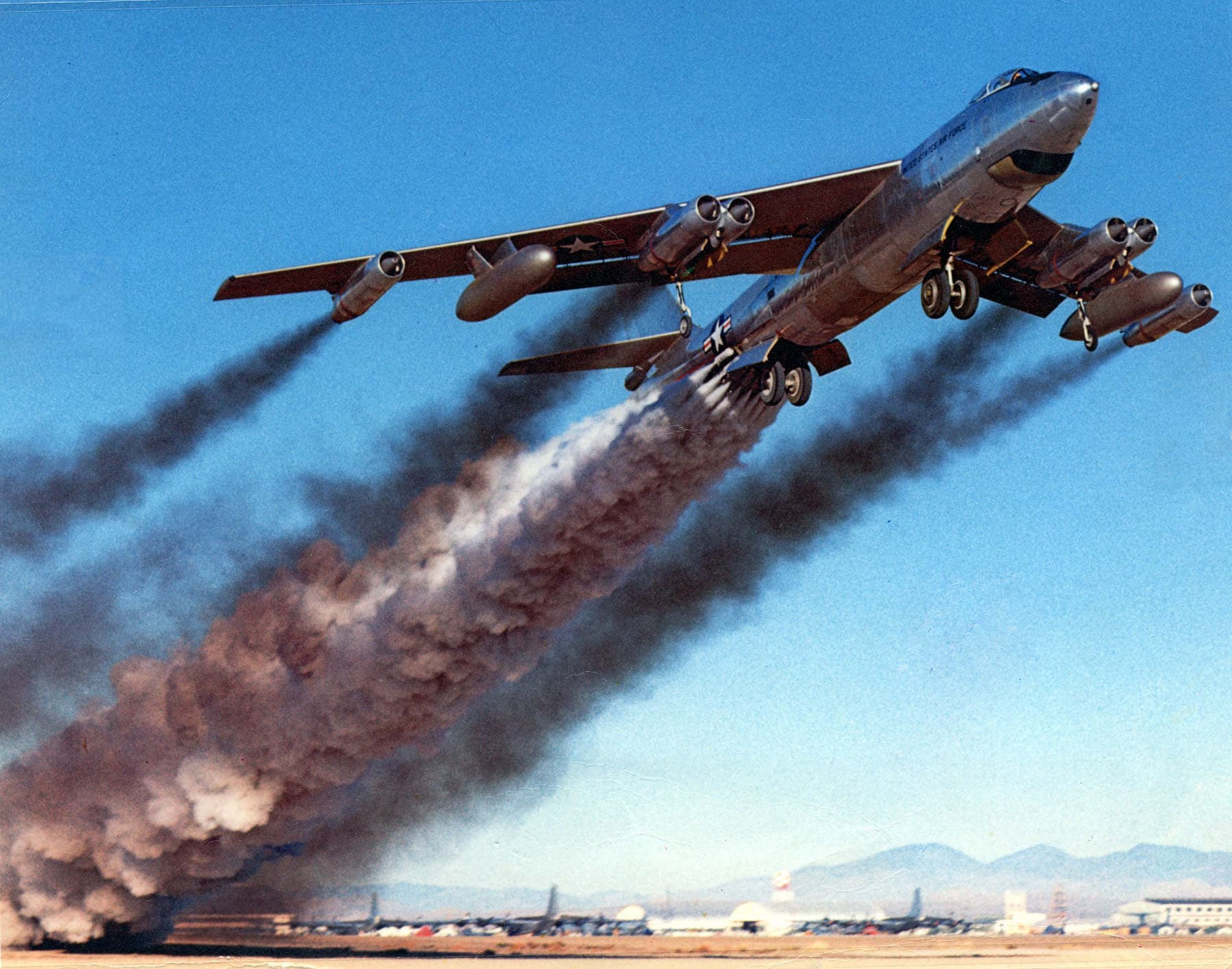
So aerodynamically clean that it could not slow down: the B-47 needed a 32-ft ribbon drag chute just to descend and land on normal runways, and an approach chute to steepen final. Heavy takeoffs needed 18 JATO rockets — the famous smoke-wreathed climbouts of 1950s newsreels. Its speed embarrassed contemporary fighters; standard evasion was simply to firewall the throttles.
Key innovations
- First swept-wing jet bomber — the configuration template for all jet transports since
- Podded underslung engines as flutter dampers and maintenance win
- Brake chute + approach chute (first operational use on a bomber)
- LABS toss-bombing maneuver: an Immelmann in a 90-ton bomber to escape its own nuclear blast
Propulsion
6× General Electric J47-GE-25
General Electric · Axial-flow turbojet · 7,200 lbf each (with water-methanol injection)
The same J47 family as the F-86 — the B-47 simply used six. Early jet engines made takeoff thrust the critical shortfall: water-methanol injection (cooling the combustor inlet to allow more fuel) and strap-on JATO bottles bridged the gap, leaving the black-smoke-and-fire takeoffs the type is remembered by. Six engines on one airframe also made the B-47 fleet the great proving ground for jet-engine logistics — overhaul cycles, spares pipelines, fuel planning — that SAC later applied to the B-52.
Specifications
The people
Lore
SAC crews flew the B-47 with fighter techniques and bomber discipline; General LeMay's standardization board could end a career over a single sloppy approach.
The LABS 'toss' delivery required pulling the bomber into a half-loop at low altitude, releasing the weapon on the way up, and rolling out inverted-to-upright headed the other way — repeated practice cracked the fleet's wing roots.
RB-47s were fired on repeatedly over international waters; one was shot down over the Barents Sea in 1960 and its survivors imprisoned in Lubyanka.
Facts for the placard
- 2,032 built — more than every other multi-engine jet bomber combined.
- The B-47 could outrun the MiG-15 at altitude in 1951.
- Boeing's 367-80 (707 prototype) team was substantially the B-47 team; the airliner's wing sweep, pods, and even cockpit philosophy carried over.
Sources & further reading
- National Museum of the USAF — Boeing B-47E Stratojet fact sheet
- Boeing — B-47 Stratojet historical snapshot
- Smithsonian National Air and Space Museum — swept-wing development records
- Photograph: A Boeing B-47B fires its 18 JATO rockets during a rocket-assisted takeoff, April 15, 1954. U.S. Air Force photo (public domain), via Wikimedia Commons.