Exhibit 02 · North American Aviation
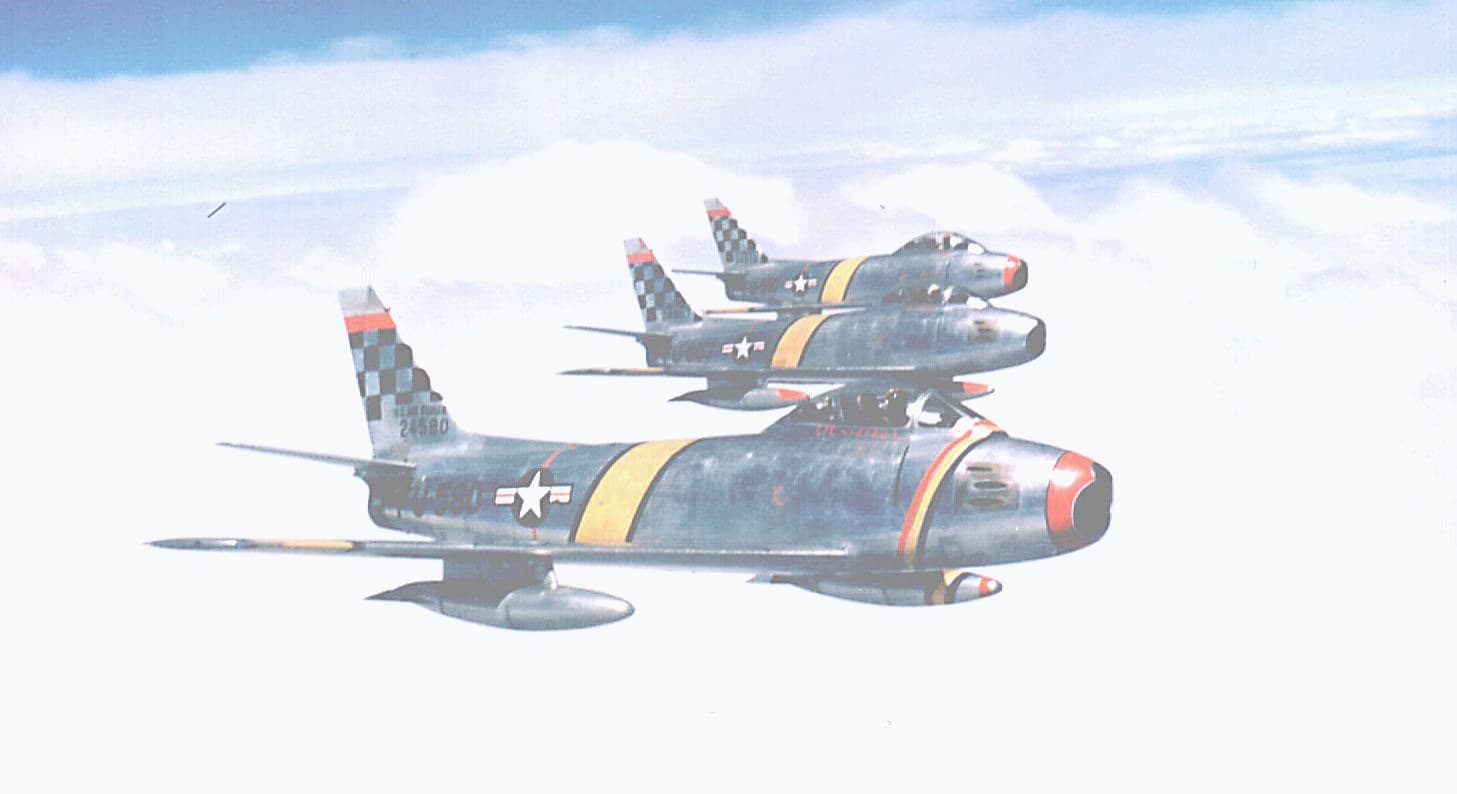
F-86 Sabre
America's first swept-wing fighter, and victor of MiG Alley.
History
The Sabre began life as a straight-wing naval jet study. In 1945, North American engineers — armed with captured German swept-wing research from the Messerschmitt archives and NACA's own independent work by Robert T. Jones — gambled on a 35° swept wing. The redesign delayed the program by months and won the transonic regime.
When MiG-15s appeared over Korea in November 1950, they outclassed every straight-wing jet in theater. The F-86A arrived weeks later. Over the next three years, Sabres fought MiG-15s in history's first large-scale jet-versus-jet air war over the Yalu River corridor — 'MiG Alley'.
USAF credited Sabre pilots with a kill ratio around 10:1 at the time; later scholarship revised it downward, but the Sabre's blend of a flying tail, radar-ranging gunsight, and superior pilot training decisively won the air war.
Why it mattered
The Sabre established the template of postwar American air superiority: take the best aerodynamic science available (German swept-wing data plus NACA research), integrate it faster than anyone else, and pair it with superior training and gunsights. It was the West's frontline fighter for a decade and equipped over 30 air forces.
Engineering breakdown
Airframe & structure
Conventional aluminum semi-monocoque fuselage with a nose intake feeding a straight-through duct to the engine — the simplest possible inlet, chosen for reliability. Wings swept 35° with automatic leading-edge slats (early variants) for low-speed handling.
Materials
Riveted aluminum alloy throughout — the mature wartime toolchain. What was new was not the material but the control system: hydraulically boosted, irreversible flight controls with an 'all-flying' horizontal tail on the F-86E, which kept the aircraft controllable through the transonic shock regime where the MiG-15's elevators lost authority.
Aerodynamics
The 35° sweep delays the drag-divergence Mach number by reducing the effective chordwise velocity component. Leading-edge slats deploy automatically at high angle of attack. The F-86 could exceed Mach 1 in a dive — routinely, and controllably, thanks to the flying tail.
Key innovations
- First operational U.S. swept-wing fighter
- All-flying tailplane (F-86E onward) — the key to transonic control, later universal on supersonic aircraft
- A-1CM gunsight coupled to AN/APG-30 ranging radar — automatic lead computation in a dogfight
- Automatic leading-edge slats balancing high-speed sweep with low-speed docility
Propulsion
General Electric J47-GE-27
General Electric · Axial-flow turbojet, 12-stage compressor, single-stage turbine · 5,910 lbf (F-86F variant)
The J47 was the first axial-flow turbojet certified for civil use in the U.S. and was produced in greater numbers (~36,500) than any other turbojet in history. Axial flow — compressing air through rows of small blades along the engine's axis rather than flinging it outward centrifugally — gave a slimmer frontal area and a path to ever-higher pressure ratios; every modern jet engine descends from this layout. Hot-section blades were forged nickel-chromium steel alloys; recreating one today is essentially a materials-and-machining exercise, which is why restored Sabres still fly.
Specifications
The people
Lore
'MiG Alley' pilots raced to become aces; 39 other pilots (plus one Marine and one Navy exchange pilot) made ace in Sabres over Korea — nearly all of America's jet aces of the war.
George Welch's claimed supersonic dive on October 1, 1947 — two weeks before Yeager — remains one of aviation's great unresolved arguments. North American was allegedly told to keep quiet so the X-1 program would hold the record.
Facts for the placard
- The Sabre held the world speed record five times between 1948 and 1953.
- Canadian-built Sabre Mk 6s with Orenda engines were widely considered the best dogfighters of the entire family.
- The last military Sabres retired from the Bolivian Air Force in 1994 — 47 years after first flight.
Sources & further reading
- National Museum of the USAF — North American F-86A Sabre fact sheet
- Smithsonian National Air and Space Museum — North American F-86A Sabre
- NASA — Robert T. Jones and the swept wing (NASA History)
- Photograph: Col. Benjamin O. Davis Jr. leads a flight of F-86 Sabres of the 51st Fighter-Interceptor Wing over Korea. U.S. Air Force photo (public domain), via Wikimedia Commons.