Exhibit 01 · Bell Aircraft
Bell X-1
“Glamorous Glennis”
The orange bullet that proved the sound barrier was a myth.
History
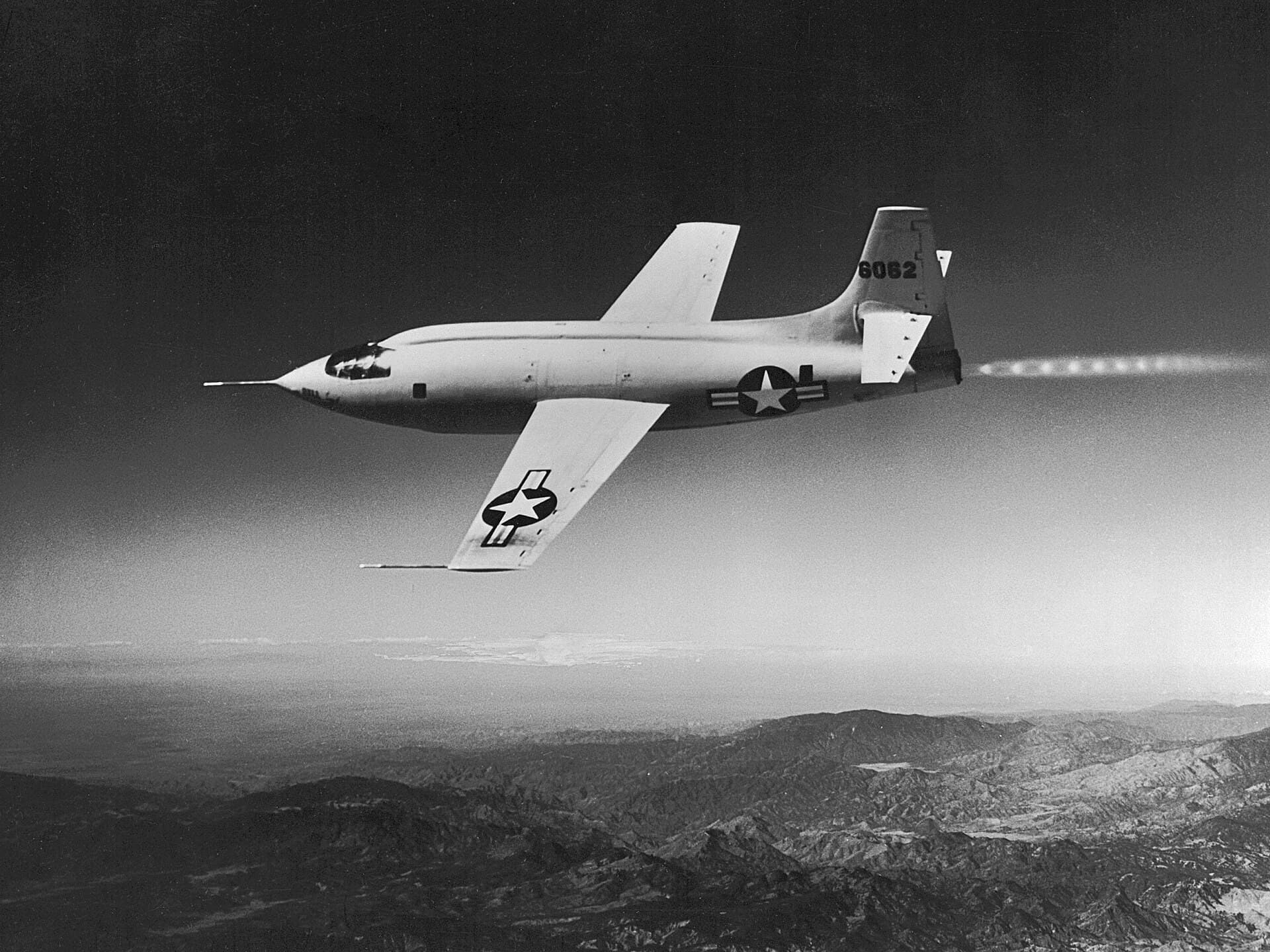
In 1944, compressibility was killing pilots: aircraft diving near the speed of sound met violent buffet, frozen controls, and — the popular press insisted — an impenetrable 'sound barrier'. The Army Air Forces and NACA commissioned Bell to build a research aircraft with no mission except to fly faster than sound and live. Bell shaped the fuselage like a .50-caliber bullet, a projectile known to fly supersonically just fine.
On October 14, 1947, over Rogers Dry Lake, Chuck Yeager dropped from a B-29 mothership, lit all four rocket chambers, and pushed the X-1 to Mach 1.06 at 43,000 feet. The 'barrier' produced a soft ba-boom on the lakebed and nothing else: the machmeter needle jumped, the flight continued, and the myth died. The flight was kept secret for eight months.
The X-1 family flew on for a decade: the X-1A took Yeager to Mach 2.44 in 1953 (and nearly killed him with inertia coupling), and the program's methods — mothership launch, rocket propulsion, lakebed recovery, NACA instrumentation — became the template for every X-plane through the X-15.
Why it mattered
The X-1 established the American research-aircraft method: a purpose-built experimental machine, a government lab (NACA), and a test-pilot corps producing flight data no wind tunnel of the era could. The data — and the confidence — behind every supersonic aircraft in this museum trace back to it. It also settled a cultural question: speed records would be set in the American desert, not claimed in theory.
Engineering breakdown
Airframe & structure
A bullet-shaped fuselage — literally modeled on the .50-caliber round — with thin (8% and 10%) straight wings built dramatically stronger than any fighter's, stressed to 18g. The horizontal stabilizer was mounted high on the fin, out of the wing's wake, and — crucially — could be pivoted in flight.
Materials
High-strength aluminum built to fighter practice but far heavier gauge; nitrogen-pressurized propellant tanks (no turbopump existed yet at this scale) fed the rocket, which cost propellant volume and limited powered flight to about 2.5 minutes.
Aerodynamics
The adjustable stabilizer saved the program. As the X-1 approached Mach 1, the shock wave migrating across the elevator hinge robbed it of authority — the same trap that had killed dive-bomber pilots. Trimming the entire tailplane restored control through the transonic regime. That discovery, shared quietly with North American, became the F-86's flying tail and then a requirement of every supersonic aircraft since.
Key innovations
- First piloted supersonic flight (Mach 1.06, October 14, 1947)
- The all-moving stabilizer lesson — arguably the single most consequential data point in transonic aerodynamics
- Bullet-derived body shape validated as a transonic form
- Mothership air-launch + rocket + lakebed landing: the X-plane operational template
Propulsion
Reaction Motors XLR11-RM-3
Reaction Motors · Four-chamber liquid rocket — ethyl alcohol/water + liquid oxygen · 6,000 lbf (four chambers of 1,500 lbf, individually ignitable)
America's first production liquid rocket engine for piloted aircraft. It could not throttle continuously — instead the pilot lit or extinguished chambers one at a time, giving four crude 'throttle' steps of 1,500 lbf each. Regeneratively cooled, pressure-fed, and almost pathologically reliable, the XLR11 outlived its era: when the X-15's big XLR99 ran late a decade later, two XLR11s powered the X-15's first flights, and surplus units pushed the lifting bodies of the 1960s. A recreation today would be a straightforward machining exercise — which is precisely its virtue; it was designed for 1946 industry to build safely.
Specifications
The people
Lore
Yeager named every aircraft he flew 'Glamorous Glennis' after his wife. The X-1 hanging in the Smithsonian still carries the name.
Two nights before the flight, Yeager broke two ribs falling from a horse at Pancho Barnes' Happy Bottom Riding Club. He told only Ridley, who cut a length of broom handle so Yeager could lever the hatch closed with his good arm.
The 'sound barrier' was largely a press invention — but the buffet and control loss were real enough that Bell's own contract pilot had demanded a bonus to fly it. Yeager did it on captain's pay.
Facts for the placard
- The X-1's supersonic flight was kept classified until June 1948; Aviation Week broke the story before the Air Force confirmed it.
- The program originated the 'X-plane' designation series that continues today (X-59, X-66).
- Total rocket burn time on the record flight: about 100 seconds.
Sources & further reading
- Smithsonian National Air and Space Museum — Bell X-1 “Glamorous Glennis”
- NASA — X-1 research aircraft (NASA History)
- National Museum of the USAF — Bell X-1B fact sheet
- Photograph: The Bell X-1 “Glamorous Glennis” in flight, shock diamonds visible in the rocket exhaust. NACA/U.S. Air Force photo (public domain), via Wikimedia Commons.