Exhibit 19 · Lockheed Martin / Boeing
F-22 Raptor
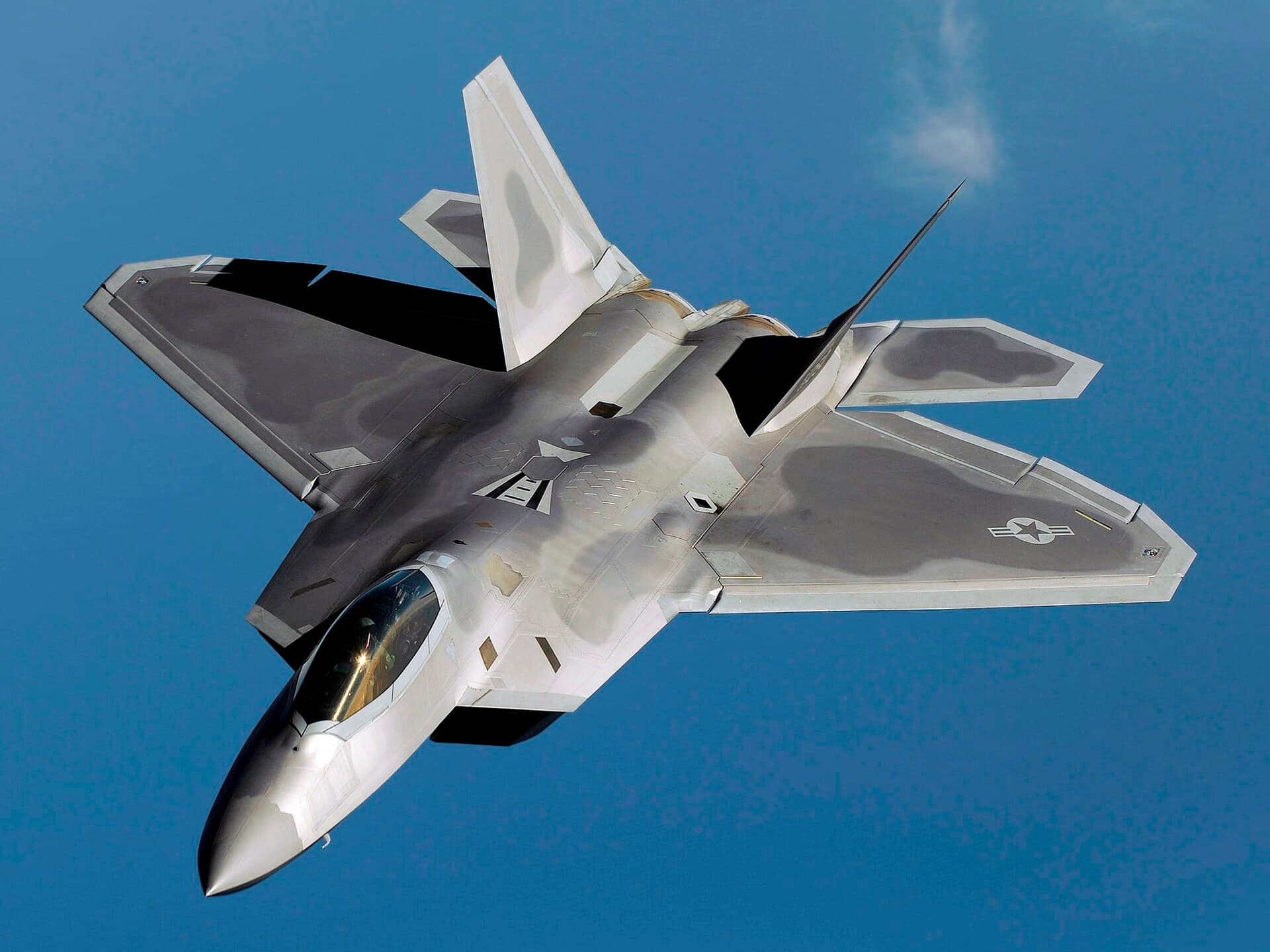
Stealth, supercruise, and sensor fusion — the fighter from a war that ended before it arrived.
History
The Advanced Tactical Fighter program of 1981 asked for the impossible combination: F-15 agility, F-117 stealth, and sustained supersonic cruise without afterburner. The 1990–91 flyoff pitted Lockheed's YF-22 against Northrop's arguably faster, stealthier YF-23; Lockheed's more conventional agility (and, many believed, more convincing program management) won.
Then the Soviet Union — the aircraft's entire justification — dissolved months later. Planned buys collapsed from 750 to 381 to 187, and production ended in 2011 with the line's tooling packed into desert storage. Congress banned export outright (the Obey Amendment), making the Raptor the only modern American fighter never offered even to allies.
In service it has been less a combatant than an argument-ender: in exercises, Raptor pilots rack up double-digit kill ratios against anything flying, and its first air-to-air kills were, absurdly, a Chinese spy balloon and cruise-missile-class drones in 2023–24. Its avionics architecture, stealth maintenance lessons, and pilot cadre seeded the F-35 and now the sixth-generation NGAD program.
Why it mattered
The F-22 closed the arc this museum traces: the swept wing (1947), Mach 2 (1954), stealth (1981), and computational flight control (1974) all converge in one airframe that does everything its ancestors did separately — and it is simultaneously a monument to Cold War momentum, arriving perfected for a conflict that no longer existed. Fewer were built than B-58s.
Engineering breakdown
Airframe & structure
Stealth shaping matured past the B-2's curves into a supersonic form: planform-aligned edges, serpentine inlets hiding the fan faces, internal weapons bays keeping the combat configuration clean, and radar-absorbent edge treatments over a structure that is roughly 39% titanium and 24% composites. Thrust-vectoring nozzles pitch ±20°, integrated into the flight controls.
Materials
Titanium hot structure and load paths, bismaleimide and epoxy composites over much of the surface, and frequency-tuned RAM — with the operational discovery that stealth coatings are a maintenance discipline as demanding as any engine: low-observable restoration became its own Air Force specialty.
Aerodynamics
Supercruise — Mach 1.5+ without afterburner — changes air combat's energy arithmetic: the Raptor enters every merge from above and faster, and leaves at will. Thrust vectoring plus relaxed stability gives controllable flight past 60° angle of attack. Sensor fusion (radar, ESM, datalinks synthesized into one tactical picture) proved as decisive as any aerodynamic number; every exercise debrief says the Raptor's kills begin with seeing first.
Key innovations
- First operational supercruising fighter (Mach 1.5+ dry)
- First stealth aircraft with fighter agility — planform-aligned supersonic shaping
- Two-dimensional thrust-vectoring nozzles integrated with fly-by-wire
- Sensor fusion as the design's actual center: the pilot commands outcomes, the machine assembles the picture
- AN/APG-77 AESA — the first operational active electronically scanned array on a fighter
Propulsion
2× Pratt & Whitney F119-PW-100
Pratt & Whitney · Afterburning twin-spool turbofan with 2D thrust-vectoring nozzles · ~35,000 lbf class each
The F119 is what a half-century of the American engine lead compounds into: single-crystal superalloy turbine blades, integrally-bladed powder-metallurgy rotors, and a low-bypass cycle hot and strong enough to push a 35-ton stealth airframe past Mach 1.5 dry — sustained, mission after mission. The flat two-dimensional nozzles vector thrust for pitch authority and flatten the exhaust plume for infrared suppression, at a weight cost only this engine's margin could absorb. Its direct derivative, the F135, powers every F-35.
Specifications
The people
Lore
The losing YF-23 — faster and stealthier by most accounts — remains aviation's favorite what-if; both prototypes sit in museums, still looking like the future.
F-22 production tooling was crated into climate-controlled storage against a restart that studies priced at prohibitive and Congress never funded.
The Raptor's first confirmed kill, after 17 years in service, was a balloon at 58,000 ft over South Carolina — engaged with a Sidewinder from history's most expensive skeet position.
Facts for the placard
- Export was banned by federal law; even Japan and Australia were refused.
- 187 operational aircraft — fewer Raptors exist than B-58 Hustlers were built.
- Exercise Northern Edge 2006: 144-to-0 simulated kill ratio against the aggressor force.