Exhibit 18 · Northrop (now Northrop Grumman)
B-2 Spirit
Jack Northrop's flying wing, resurrected by computers and cloaked from radar.
History
Jack Northrop spent the 1940s building flying wings — the piston YB-35 and jet YB-49 — convinced the tailless wing was aviation's purest form. The Air Force cancelled them; the type seemed dead. But a flying wing has no fuselage, no tail, and no corners: it is, almost by accident, the ideal stealth shape once computers can both stabilize it and compute its curved-surface radar returns.
Northrop won the Advanced Technology Bomber competition in 1981. In 1980, the company brought the dying Jack Northrop — 85, unable to speak — into a secure room and showed him the ATB model. He wrote on a notepad: 'Now I know why God has kept me alive for 25 years.' He died ten months later, nine years before the B-2 flew.
Cold War plans for 132 aircraft collapsed to 21, driving the notorious per-unit cost above $2 billion. Those 21 aircraft flew from Missouri to Serbia, Afghanistan, Iraq, and Libya — 30+ hour round trips from home base — and in 2025 delivered the GBU-57 strikes on Iranian nuclear facilities, the mission the aircraft's massive-ordnance capability existed for.
Why it mattered
The B-2 closed a 40-year loop: an aerodynamic ideal abandoned for uncontrollability returned as the optimal stealth platform, flyable only through digital flight controls. It merged the two great postwar revolutions — computational stealth and fly-by-wire — into a single aircraft, and its curved stealth (versus the F-117's facets) is a direct artifact of a decade's growth in computing power.
Engineering breakdown
Airframe & structure
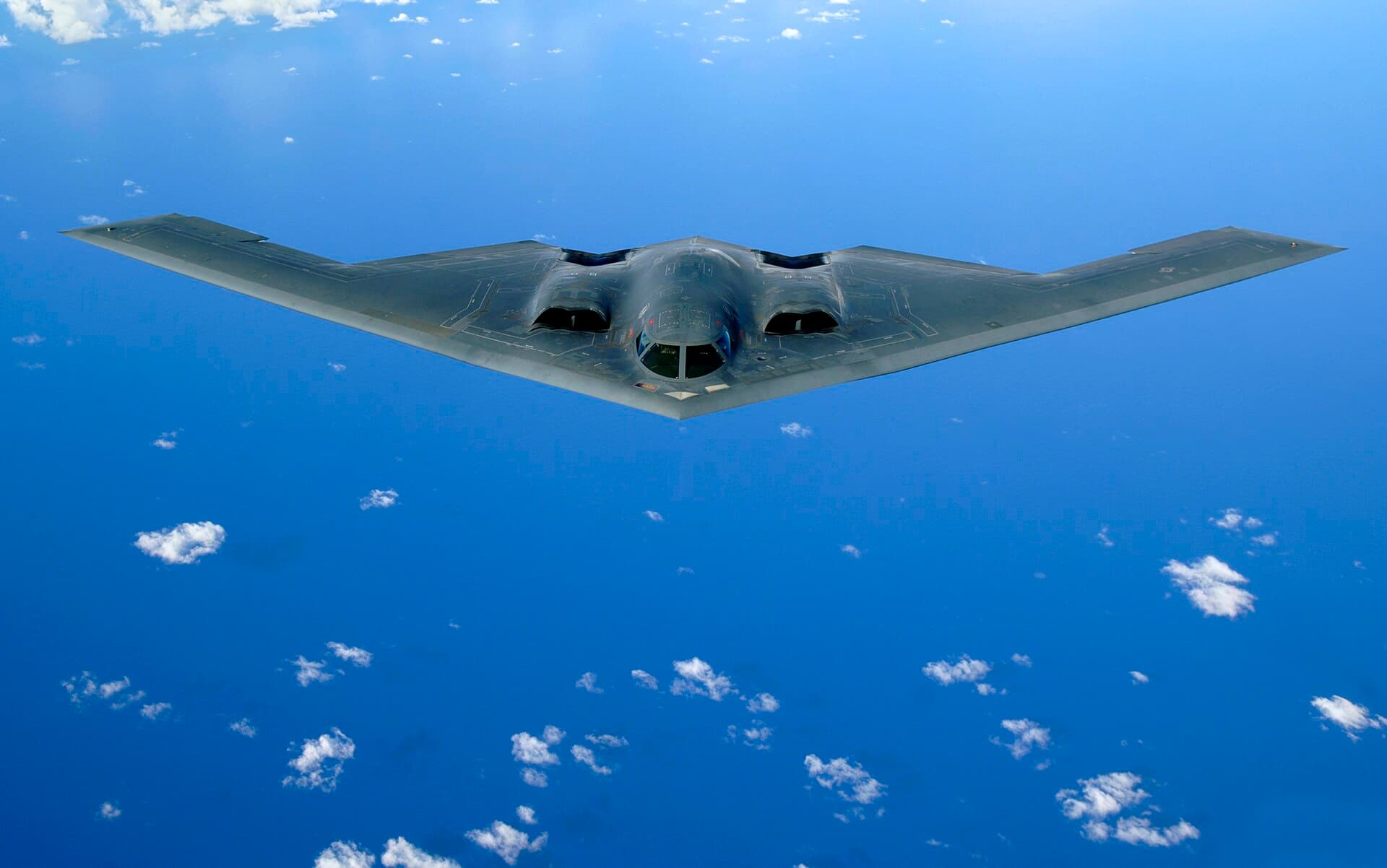
A pure flying wing, 172 feet tip to tip, with no vertical surfaces at all. Yaw control comes from split drag rudders at the wingtips that open like clamshells; a quadruply-redundant digital fly-by-wire system commands every surface, since a tailless wing is unstable in pitch and yaw. The trailing edge's double-W sawtooth aligns every edge to a few radar-scattering directions.
Materials
Largely carbon-fiber composite structure — one of the biggest composite airframes ever built — with honeycomb radar-absorbent structures and coatings tuned across radar bands. Curved (not faceted) stealth shaping, computable by the 1980s supercomputers unavailable to the F-117's designers, gives low observability plus real aerodynamic efficiency: intercontinental range from a bomber with a fighter's radar signature.
Aerodynamics
The flying wing is the lowest-drag configuration possible — every square foot lifts. With engines buried in the wing, S-duct inlets atop the surface, and exhausts shielded above the trailing edge, the B-2 hides from radar below and infrared sensors behind while cruising with airliner-class efficiency.
Key innovations
- Curved-surface computational stealth (second-generation, beyond faceting)
- Split drag-rudder yaw control on a tailless aircraft
- Buried engines with S-duct inlets and over-wing shielded exhausts
- GPS-aided targeting making a strategic bomber a precision all-weather striker
- Climate-controlled shelters and specialized RAM maintenance — stealth as a sustained operational discipline
Propulsion
4× General Electric F118-GE-100
General Electric · Non-afterburning turbofan (F110 core) · 17,300 lbf each
A derivative of the F110 fighter engine core, de-rated and optimized for efficient subsonic cruise with no afterburner (an afterburning bomber would be an infrared bonfire). The engineering story is less the engine than its installation: buried deep in the wing behind S-shaped ducts so radar can never see the spinning fan face — a classic stealth trade, sacrificing inlet efficiency for invisibility — with exhaust spread over cooled trailing-edge surfaces to smear the heat signature.
Specifications
The people
Lore
Each B-2 is named 'Spirit of' a state. With 21 aircraft and 50 states, being a B-2 state is a minor political honor.
The 1989 rollout revealed the top-secret shape — but Northrop kept the trailing edge hidden from the crowd. An Aviation Week photographer rented a Cessna and legally photographed it from directly above; the FAA had never closed the airspace.
B-2 crews fly 30+ hour missions from Missouri with a cot, a microwave, and a chemical toilet behind the seats.
Facts for the placard
- At $2.2 billion per aircraft (program cost over 21 aircraft), the B-2 is the most expensive aircraft ever built.
- Its radar cross-section is reported to be comparable to a large bird's, on an aircraft with a 172-ft wingspan.
- The YB-49 flying wing of 1947 had the same 172-ft wingspan as the B-2 — Northrop's geometry was right the first time; only the control computers were missing.