Exhibit 17 · General Dynamics (now Lockheed Martin)
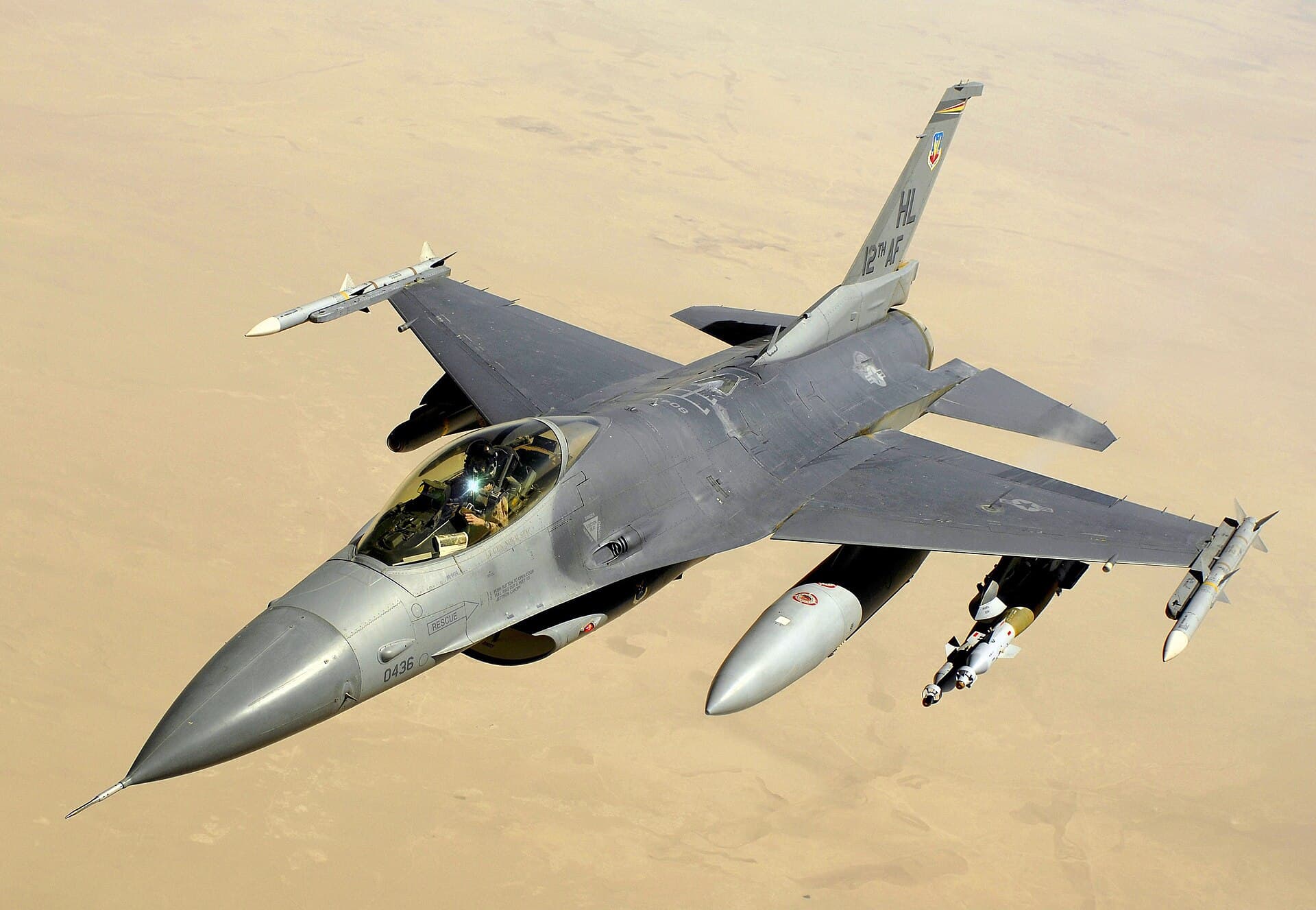
F-16 Fighting Falcon
“Viper”
The Fighter Mafia's heresy: small, unstable, fly-by-wire — and it conquered the world.
History
The F-16 exists because a guerrilla faction inside the Pentagon — John Boyd, Pierre Sprey, Everest Riccioni, with Harry Hillaker inside General Dynamics — believed Vietnam proved fighters had grown too big, too heavy, and too expensive. Boyd's energy-maneuverability theory quantified agility for the first time; the 'Fighter Mafia' pushed a Lightweight Fighter competition against institutional resistance.
The YF-16 beat Northrop's YF-17 in a 1974 flyoff (the YF-17 evolved into the Navy's F/A-18). NATO's 'sale of the century' made it the Western world's standard fighter, assembled simultaneously on lines in Texas, Belgium, and the Netherlands.
Israeli F-16s destroyed Iraq's Osirak reactor in 1981 and swept Syrian MiGs from the Bekaa Valley in 1982. Five decades on, new-build Block 70 F-16s are still rolling out of Greenville, South Carolina.
Why it mattered
The F-16 institutionalized two revolutions at once: relaxed static stability (the airframe is deliberately unstable, tamed by computers, gaining agility no stable design can match) and design-to-energy-maneuverability rather than design-to-top-speed. It is the most numerous fighter of the jet age's second half and the benchmark every light fighter is measured against.
Engineering breakdown
Airframe & structure
A blended wing-body — the fuselage and wing merge smoothly, generating lift everywhere and housing fuel in the blend. Leading-edge strakes spin up vortices that keep the wing lifting past 25° angle of attack. The single F100 breathes through a simple fixed chin inlet, shielded by the fuselage at high alpha.
Materials
About 80% aluminum — the F-16's revolution was configuration and controls, not materials. Later blocks add composite tails and structural reinforcement as weight grew from 22,000 lb (YF-16) toward 48,000 lb (Block 70).
Aerodynamics
The center of gravity sits behind the aerodynamic center: left alone, the airframe diverges in under a second. The quadruplex analog (later digital) fly-by-wire system restabilizes it 40+ times a second, converting instability into instant pitch response. The pilot's side-stick barely moves — it senses force, not displacement — and the seat reclines 30° to raise g-tolerance.
Key innovations
- First production relaxed-static-stability aircraft — computers make it flyable, instability makes it lethal
- First production full-authority fly-by-wire with no mechanical backup
- 30° reclined seat + sidestick + single-piece bubble canopy with 360° view
- 9g sustained capability — the first fighter built to it as a requirement
Propulsion
Pratt & Whitney F100-PW-229 / GE F110-GE-129 (alternate fitment)
Pratt & Whitney / General Electric · Afterburning twin-spool turbofan · ~29,000 lbf class with afterburner
The F100 was the first fighter turbofan with a thrust-to-weight ratio near 8:1, sharing a core lineage with the F-15's engines. Early F100s suffered stagnation stalls; the resulting 'Great Engine War' — the Air Force qualifying GE's F110 as a competing alternate engine in 1984 — is a landmark case study in how competition fixed reliability and price. A single engine means every F-16 pilot memorizes glide profiles: engine-out landings are a practiced maneuver, not an emergency improvisation.
Specifications
The people
Lore
The F-16's official first flight happened by accident — the YF-16 became airborne during a taxi test to escape a control oscillation striking the runway.
Pilots universally call it the Viper, after Battlestar Galactica's fighters; 'Fighting Falcon' is strictly for press releases.
The Fighter Mafia held design sessions in the Pentagon Officers' Club; Boyd's briefings were so combative they were scheduled like prizefights.
Facts for the placard
- 4,600+ built, flown by 25+ countries, still in production after 50 years.
- The YF-16/YF-17 flyoff produced both the F-16 and (via the losing design) the F/A-18 Hornet — the most productive competition in fighter history.
- Block 70 aircraft rolling out today carry an automatic ground-collision avoidance system credited with saving a dozen pilots.