Exhibit 16 · McDonnell Douglas (now Boeing)
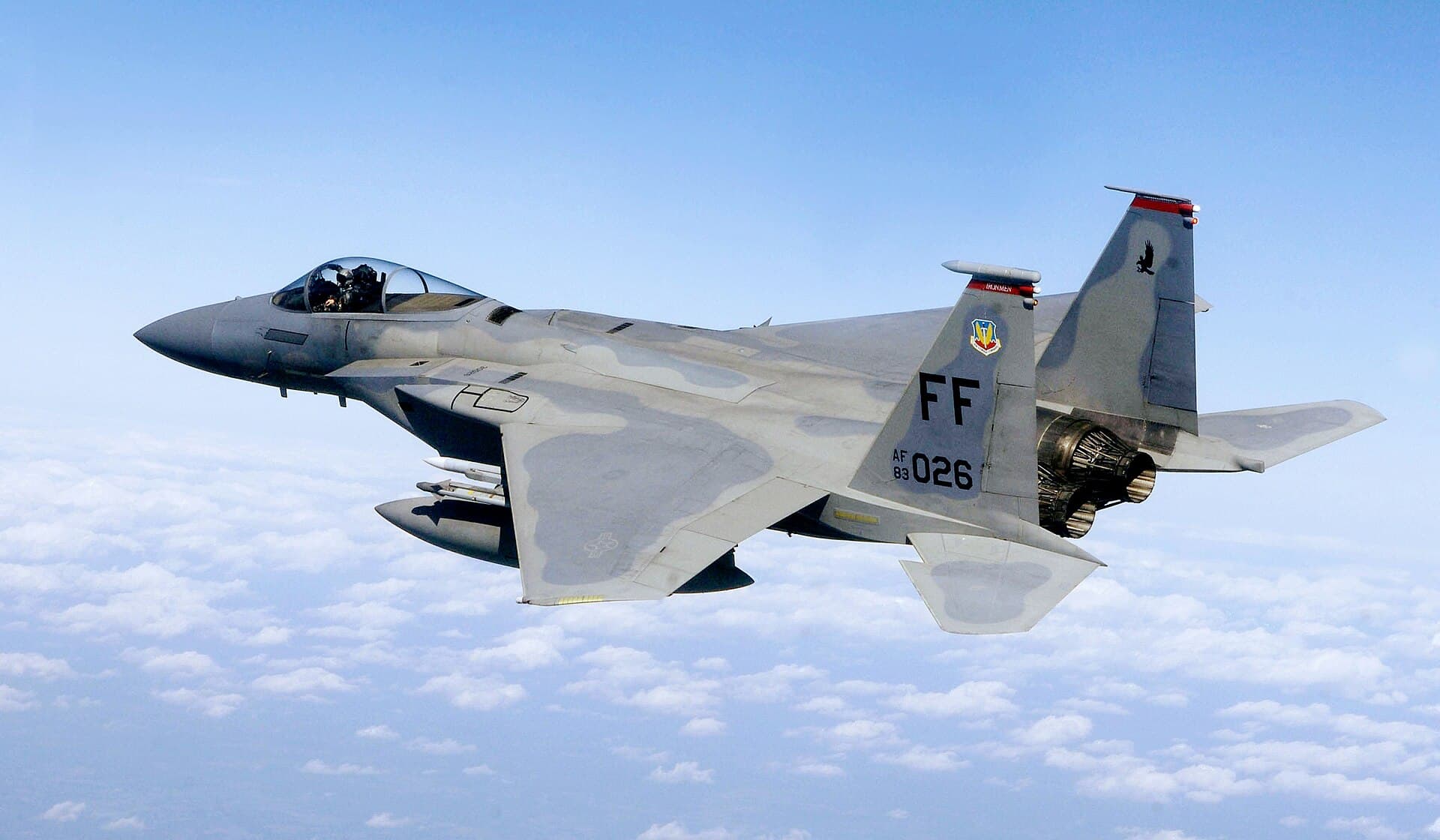
F-15 Eagle
Not a pound for air-to-ground: 104 victories, zero defeats.
History
Two shocks produced the Eagle: Vietnam, where missile-armed Phantoms struggled against agile MiGs, and the 1967 unveiling of the Soviet MiG-25, whose huge wing and Mach 3 speed read (wrongly, it turned out) as a super-fighter. The FX program answered with a single-minded requirement summarized in the program office's unofficial motto: 'Not a pound for air-to-ground.'
John Boyd's energy-maneuverability theory shaped the specification: thrust-to-weight above 1, wing loading low enough to out-turn anything, a radar that could look down over clutter, and a bubble canopy restoring the eyesight the Phantom had lost. McDonnell Douglas delivered an aircraft that could accelerate straight up and turn with fighters half its size.
The combat record is the cleanest in fighter history: 104 aerial victories, zero losses, most of them scored by Israel — including a 1982 Bekaa Valley campaign that erased Syria's air force — plus USAF kills over Iraq and the Balkans. When the MiG-25 defected to Japan in 1976 and proved to be a steel interceptor with vacuum tubes, the Eagle it had provoked was already better than the threat had ever been. Fifty years on, the F-15EX is still rolling off the line in St. Louis.
Why it mattered
The F-15 restored the air-superiority mission as a design discipline after a decade of multirole compromise, and its unbeaten record is the empirical case for the American formula of the 1970s: E-M theory requirements, twin F100 engines, a big radar, and relentless pilot training (the same era founded Red Flag). With the F-16 it forms the high-low pair that defined Western air power for half a century.
Engineering breakdown
Airframe & structure
A large shoulder-mounted cropped-delta wing (608 sq ft, wing loading around 65 lb/sq ft — fighter-low) on twin podded engines fed by two-dimensional variable inlets that rotate nose-down at high angle of attack to keep the engines breathing. Twin vertical tails clear the wing wake in hard maneuvering. About 26% titanium by weight, concentrated in the engine bay and wing carry-through.
Materials
Titanium where heat and load demand it, conventional aluminum elsewhere — a deliberate step back from exotic structure toward producibility. The design proved absurdly damage-tolerant: in 1983 an Israeli F-15 landed after a mid-air collision removed one wing almost entirely at the root — the pilot didn't realize the wing was gone until he climbed out.
Aerodynamics
Low wing loading plus thrust-to-weight above 1 is the whole E-M argument in hardware: the Eagle sustains turns that bleed opponents' energy and regains it instantly. The APG-63 radar's look-down/shoot-down capability removed the low-altitude sanctuary MiGs had exploited over Vietnam.
Key innovations
- First fighter with thrust-to-weight exceeding 1 at combat weight
- Look-down/shoot-down pulse-Doppler radar (APG-63); first programmable radar signal processor
- HOTAS — hands-on throttle and stick — pioneered as a design doctrine
- F-15 Streak Eagle stripped of paint took the time-to-climb records from the MiG-25 in 1975: sea level to 98,000 ft in 3 minutes 28 seconds
Propulsion
2× Pratt & Whitney F100-PW-100 (later -220/-229; F110 in some export variants)
Pratt & Whitney · Afterburning twin-spool turbofan · 23,930 lbf each with afterburner
The F100 was the great leap: nearly 8:1 thrust-to-weight from 3,036°F turbine temperatures enabled by directionally-solidified blades and powder-metallurgy discs — metallurgy nobody else could produce at scale, the concrete form of the U.S. engine lead. Early engines paid for the ambition with stagnation stalls and rapid wear; the resulting maturation program (and the F-16-driven Great Engine War) forged the modern discipline of fighter-engine reliability. The same core family, matured, powers the F-15EX today at 29,000 lbf.
Specifications
The people
Lore
'Not a pound for air-to-ground' — the FX office's vow was so thoroughly honored that the Eagle waited 15 years before anyone dared hang bombs on it (the F-15E Strike Eagle, a different beast, apologized for the heresy by becoming the best strike aircraft in the world).
The Streak Eagle record flights were flown in bare metal in a St. Louis winter; paint weighed 40 pounds and the team wanted the records more than the corrosion protection.
In September 1985, an F-15 climbed to 38,000 ft and killed an orbiting satellite with an ASM-135 missile — the only air-launched satellite kill in history.
Facts for the placard
- 104:0 — no F-15 has ever been lost in air-to-air combat, across four decades and three air forces.
- The 1976 MiG-25 defection revealed the fearsome threat that justified the F-15 was a 64,000-lb stainless-steel interceptor that could barely turn.
- New-build F-15EX airframes are rated for 20,000 flight hours — five times the F-15A's original design life.